
The Modern Offshore AEC Professional: A Strategic Partner in Project Delivery
February 5, 2026
A New Kind of Partner in Modern AEC Projects
If you still picture offshore AEC support as a back-office drafting function, you’re not alone — but that picture is rapidly becoming outdated. Across architecture, engineering, and construction, firms are discovering that offshore professionals are no longer just production resources. They are strategic collaborators embedded in project delivery.
From BIM coordination to high-level design leadership, today’s offshore AEC professionals contribute directly to decision-making, risk management, and performance optimization. As project complexity increases and timelines tighten, firms are turning to globally integrated teams not just to scale capacity, but to strengthen expertise.
This evolution is redefining how projects are delivered — and it is creating new opportunities for firms that are ready to think beyond traditional outsourcing models.
The Industry Evolution: From Support Function to Strategic Integration
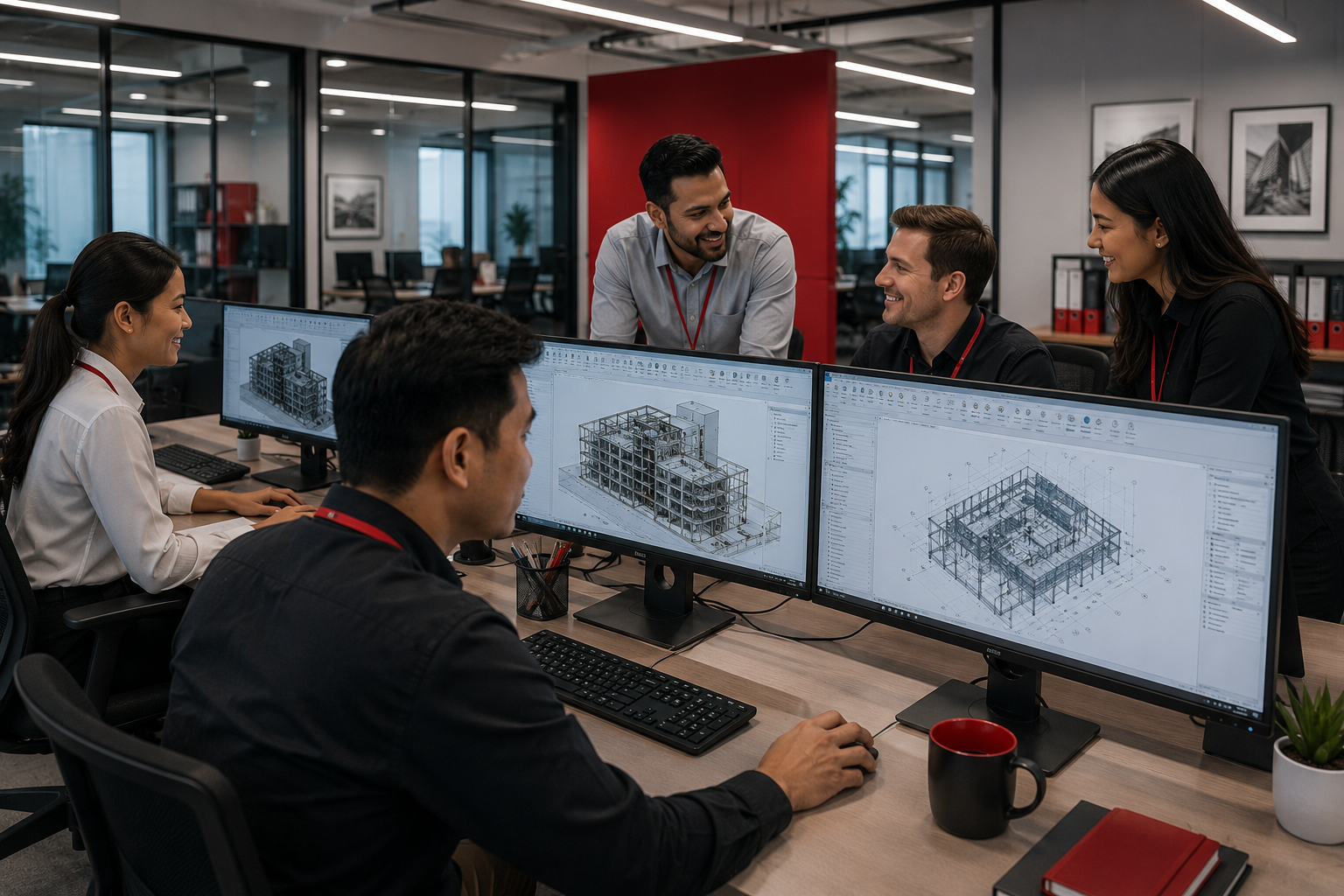
The most important shift in offshore AEC services is the move from isolated task execution to integrated collaboration. Advances in BIM ecosystems, cloud-based platforms, and real-time communication tools allow distributed teams to function as a unified studio.
Modern offshore professionals now play active roles in:
- Design development and technical detailing
- Regulatory and code compliance reviews
- BIM coordination and clash management
- Workflow optimization and process improvement
- Strategic problem-solving across disciplines
This transformation is driven by access to highly specialized global talent and a partnership model built around integration rather than delegation. Offshore teams are increasingly embedded throughout the full project lifecycle, contributing expertise that influences schedules, budgets, and design outcomes.
Profile 1: The BIM Coordinator — Core Technical Leadership
In complex AEC projects, coordination is the backbone of successful delivery. Offshore BIM Coordinators serve as digital integrators who ensure that multidisciplinary models align technically and procedurally.
Their responsibilities extend well beyond clash detection. A modern BIM Coordinator:
- Develops and manages BIM execution plans
- Enforces modeling standards across teams
- Facilitates coordination workshops
- Identifies constructability and sequencing risks
- Verifies compliance with clearance and accessibility requirements
Through proactive model analysis and workflow refinement, BIM Coordinators help eliminate recurring conflicts before they reach construction. Standardized detailing strategies and improved phasing protocols within collaborative environments such as BIM 360 can significantly reduce rework and maintain project momentum.
Their value lies in preventing problems before they materialize — a critical advantage in fast-moving projects.
Profile 2: The Senior Architect — Strategic Design Expertise
At the advanced tier of offshore collaboration are licensed architects and senior technical leaders who actively shape project direction. These professionals function as extensions of in-house studios, contributing at a strategic level.
A senior architect may lead:
- Schematic design and massing exploration
- Zoning and entitlement analysis
- Building code and compliance reviews
- Daylight and spatial efficiency studies
- Client-facing design presentations
On challenging sites, senior architects can reconfigure façades and building massing to satisfy regulatory constraints while preserving design intent and program requirements. By presenting alternatives directly to decision-makers, they participate as full partners in the design process.
This represents a shift from remote support to integrated leadership.
From Task Execution to Thought Partnership
Across all roles, a common theme emerges: offshore AEC professionals are increasingly engaged as intellectual contributors to project success.
Key characteristics define this modern model:
- Strategic problem-solving: Professionals are expected to analyze, recommend, and optimize solutions.
- Proactive compliance management: Expertise in international codes and standards reduces regulatory risk.
- Advanced technology fluency: Mastery of BIM platforms and performance tools enables seamless collaboration.
- Integrated communication: Participation in design sprints and coordination meetings positions offshore teams as core contributors.
ADDMORE Services LLC operates on this principle of integration. As a professional technical services company providing offshore outsourcing for the AEC industry, ADDMORE builds dedicated teams that align with each client’s workflows and culture. Its tiered structure allows firms to scale from production support to senior leadership expertise, balancing cost efficiency with expanded capability.
Building a Collaborative Advantage
For AEC firm leaders, the central question is no longer whether drafting can be outsourced. The real question is how global expertise can be integrated to amplify in-house strengths.
Firms that adopt collaborative offshore partnerships gain measurable advantages:
- Expanded capacity without proportional overhead growth
- Access to specialized expertise on demand
- Faster and more predictable project delivery
- Improved technical coordination and compliance
- Greater focus on innovation and client relationships
Modern offshore professionals contribute to constructability solutions, sustainability analysis, and regulatory navigation. Organizations that continue to view offshore services through a narrow production lens risk overlooking a significant strategic opportunity.
Conclusion: Strategic Partnership as a Competitive Edge
The rise of the modern offshore AEC professional reflects a broader industry movement toward hybrid, globally connected studios. Strategic partnerships allow firms to extend their technical reach, improve resilience, and deliver higher-value results.
Ready to explore how a strategic offshore partnership can strengthen your project delivery? Contact ADDMORE Services LLC for a free consultation to discuss your firm’s goals and challenges. Discover how integrated offshore AEC professionals can operate as true partners in your success.

Bid season overloads estimators. Learn how to split takeoff work by task, trade, and surge capacity so your team can bid more and measure less.
Workloads in architecture, engineering, construction, and development firms rarely move in a straight line. A large bid lands, a project hits its documentation peak, or a key person goes on leave. Other times the gap is permanent: the team has simply outgrown the people it has. The same is true beyond design and delivery. Growing firms also need business technology specialists to run their CRM, business systems, AI tools, and day-to-day technology support. Sometimes that need is a short push, such as a system rollout. Sometimes it is ongoing. These are two different needs, and they call for two different answers. That is why Professional Talent Outsourcing comes in two models, each with its own method of engagement. What Professional Talent Outsourcing is Professional Talent Outsourcing adds professional capacity to your team on a monthly rate, from AEC professionals to business technology specialists. ADDMORE draws on a network of pre-qualified nearshore independent professionals in Latin America, who work in or close to your time zone, with further choice offshore in South Africa and the Philippines. Wherever they are based, they work on your systems, to your standards, as part of your team. This is managed augmentation, not transactional staffing. ADDMORE matches each professional to your business style and culture, then stays involved for performance and continuity. Why two models? The difference is not only how long you need someone. It is how the professional is engaged and who carries the compliance risk. Three to six months: ADDMORE engages the professional as Contractor of Record. Six months or more: the risk of employer and employee misclassification increases, so ADDMORE engages a trusted third-party Employer of Record to employ the professional. In both models, you hold one services agreement with ADDMORE, and ADDMORE takes on the classification risk. That removes the responsibility from you. Model 1: Staff Augmentation Staff Augmentation is flexible support for a defined term, generally three to six months. It suits: a project peak or a tender with a hard deadline a backlog of drawings, models, or documentation a system rollout or migration cover while a team member is on leave testing a new role before committing to it long-term ADDMORE is the contracting party holding the agreement and handles payments and compliance on your behalf, acting as the Contractor of Record. The cost of this is built into your rate. Model 2: Embedded Talent Embedded Talent is for six months or more, and it is the model we recommend. The professional becomes a long-term member of your team, integrated into your workflows, your software and your way of working. Because the relationship is built to last, ADDMORE manages it for the long run. Embedded professionals are encouraged to upskill in AI every month and are managed for performance, continuity, and retention. The engagement runs through a trusted third-party Employer of Record, engaged by ADDMORE. This gives the professional proper employment and keeps you clear of misclassification risk. Because it includes the Employer of Record, the Embedded Talent rate is slightly higher than Staff Augmentation. One all-inclusive rate Whichever model you choose, the rate in your ADDMORE proposal is all-inclusive. The method of engagement, Contractor of Record or Employer of Record, is built into the price. There are no separate, hidden, or additional fees. Side by side

Discover how talent gaps affect AEC project delivery, profitability, and team capacity, and how outsourcing can help firms close staffing gaps.