
Short Term or Long Term? Two Ways to Add Professional Capacity

October 30, 2026

Workloads in architecture, engineering, construction, and development firms rarely move in a straight line. A large bid lands, a project hits its documentation peak, or a key person goes on leave. Other times the gap is permanent: the team has simply outgrown the people it has.


The same is true beyond design and delivery. Growing firms also need business technology specialists to run their CRM, business systems, AI tools, and day-to-day technology support. Sometimes that need is a short push, such as a system rollout. Sometimes it is ongoing.


These are two different needs, and they call for two different answers. That is why Professional Talent Outsourcing comes in two models, each with its own method of engagement.
 

What Professional Talent Outsourcing is


Professional Talent Outsourcing adds professional capacity to your team on a monthly rate, from AEC professionals to business technology specialists. ADDMORE draws on a network of pre-qualified nearshore independent professionals in Latin America, who work in or close to your time zone, with further choice offshore in South Africa and the Philippines. Wherever they are based, they work on your systems, to your standards, as part of your team.


This is managed augmentation, not transactional staffing. ADDMORE matches each professional to your business style and culture, then stays involved for performance and continuity.
 

Why two models?


The difference is not only how long you need someone. It is how the professional is engaged and who carries the compliance risk.
 

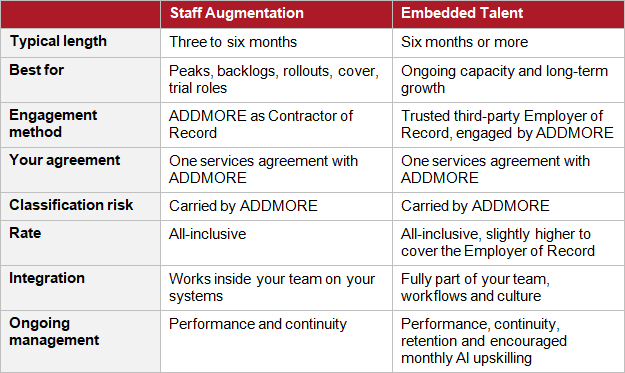
  • Three to six months: ADDMORE engages the professional as Contractor of Record.


  • Six months or more: the risk of employer and employee misclassification increases, so ADDMORE engages a trusted third-party Employer of Record to employ the professional.
     

In both models, you hold one services agreement with ADDMORE, and ADDMORE takes on the classification risk. That removes the responsibility from you.
 

Model 1: Staff Augmentation


Staff Augmentation is flexible support for a defined term, generally three to six months. It suits:

  • a project peak or a tender with a hard deadline
  • a backlog of drawings, models, or documentation
  • a system rollout or migration
  • cover while a team member is on leave
  • testing a new role before committing to it long-term


ADDMORE is the contracting party holding the agreement and handles payments and compliance on your behalf, acting as the Contractor of Record. The cost of this is built into your rate.
 

Model 2: Embedded Talent


Embedded Talent is for six months or more, and it is the model we recommend. The professional becomes a long-term member of your team, integrated into your workflows, your software and your way of working.
 

Because the relationship is built to last, ADDMORE manages it for the long run. Embedded professionals are encouraged to upskill in AI every month and are managed for performance, continuity, and retention. The engagement runs through a trusted third-party Employer of Record, engaged by ADDMORE. This gives the professional proper employment and keeps you clear of misclassification risk.
 

Because it includes the Employer of Record, the Embedded Talent rate is slightly higher than Staff Augmentation.
 

One all-inclusive rate


Whichever model you choose, the rate in your ADDMORE proposal is all-inclusive. The method of engagement, Contractor of Record or Employer of Record, is built into the price. There are no separate, hidden, or additional fees.


Side by side
Which one fits?


Start with one question: how long will you need this person? If the honest answer is a few months, Staff Augmentation keeps things flexible. If the work is not going away, Embedded Talent gives you continuity and a stable, compliant long-term arrangement.
 

Many firms start with one and move to the other. A short engagement that proves its value can become a long-term embedded role, with the engagement moved to an Employer of Record.
 

Roles we place


Architects and Interior Designers, CAD and Revit Professionals, BIM and Virtual Design and Construction Specialists, Planners and Project Managers, Commercial and Contract Professionals, Furniture, Fixtures and Equipment (FF&E) and Design Professionals, and business technology specialists, including CRM, business systems and AI support.
 

Why it works


The advantage is not cost. It is capability, compliance handled for you, and skilled professionals working on your systems as part of the way you deliver.
 

Work With ADDMORE. Tell us what you need and how long you need it. We will recommend the right model. [Book a Discovery Call link]


October 28, 2026
Discover how talent gaps affect AEC project delivery, profitability, and team capacity, and how outsourcing can help firms close staffing gaps.
October 20, 2026
What AEC Firms Actually Need to Hire Remote Professionals Introduction Over the last few years, "employer of record" has become the default answer to a simple question: how do I hire someone in another country? Heavy marketing from global EOR platforms taught a generation of buyers that remote hiring starts and ends with a legal employment contract. For architecture, engineering, construction, and development firms, that answer covers the paperwork and very little of the work. An EOR can make a remote architect legally employable. It cannot tell you whether that architect can produce a coordinated Revit model to your standards, work your hours, or slot into your project team without slowing everyone down. This article explains what an employer of record actually does, why it became the default, and what AEC firms need instead when they want to hire remote AEC professionals who perform from week one. What is an employer of record? An employer of record (EOR) is a company that legally employs a worker on your behalf in a country where you have no legal entity. The EOR holds the employment contract, runs payroll, pays statutory contributions and keeps you compliant with local labor law. You direct the day-to-day work. In short, the EOR answers one question: who legally employs this person? It does not answer who the right person is, how they will be vetted, or how they will fit into your firm. Why EOR became the default answer Three shifts pushed EOR into the spotlight: Remote work made single hires practical. Once teams worked on screens, hiring one architect or one BIM coordinator overseas became as workable as hiring a whole team. Informal contractor arrangements needed cleaning up. Many firms had paid overseas workers directly with no compliant contract. Audits, due diligence and disputes pushed them towards formal employment. Marketing made EOR the category. Well-funded platforms advertised "hire anyone, anywhere" so widely that many buyers now ask for EOR before they know what they need. None of this is wrong. Compliance matters. But for AEC firms, the legal wrapper is the smallest part of a successful remote hire. The gap EOR leaves for AEC firms When an architecture practice or general contractor hires remotely, the hard questions are technical and operational, not legal: Finding the right professional. A Revit architect, a BIM coordinator and a quantity surveyor are not interchangeable. General job boards and EOR marketplaces rarely screen for software depth, drawing standards or US code familiarity. Vetting by people who know the work. A CV says "BIM experience." Only a built environment professional can tell whether that means clash detection on large commercial projects or tidying up a few families. Time zone alignment. On a live project, a question that waits overnight costs a day. Overlap with your working hours matters more than the rate card. Embedding in your team. The professional should work on your systems, follow your processes and sit in your project meetings, not hand work over a wall. Choosing the right engagement. Some roles suit an independent contractor arrangement. Longer placements may be better served by an employer of record. That choice should follow the role, not a platform's default product. This is the space buyers usually mean when they search for staff augmentation. In AEC, it is less about adding headcount and more about adding the right capability to a project team. What AEC firms actually need instead ADDMORE works with general contractors, specialist contractors, architects, interior designers and civil engineers. We approach remote hiring through intelligent resourcing: a network of pre-qualified nearshore independent professionals in Latin America and offshore in South Africa and the Philippines, supporting the client. There are two ways to work with us, depending on how long you need the professional. Professional Talent Outsourcing ADDMORE sources and engages the professional, and your team directs the daily work. The professional is embedded in your team, works on your systems and processes, and keeps hours that overlap with yours. You get the capability without building a hiring and compliance operation in another country. A. Professional Offshore Talent Staff Augmentation (POTSA). For short-term needs, generally three to six months. When a deadline, a workload spike or a skills gap calls for extra capacity, POTSA adds experienced offshore professionals to your existing team without adding permanent headcount. They follow your processes, use your tools and report to your managers, working like internal team members without being on your payroll. Engagements are typically arranged through an Independent Contractor or Contractor of Record (COR) agreement, subject to applicable worker classification requirements. B. Professional Offshore Talent, Unit or Division (POT, POU or POD). Recommended. For long-term engagements of six months or more. ADDMORE provides a dedicated professional or builds a specialist production unit or a complete offshore division that works as a true extension of your in-house team. Each professional is matched to your business style and culture, fully integrated with your systems and processes, and upskilled monthly in AI. We manage performance, continuity and retention, so the knowledge built on your projects stays with your team. This is managed augmentation, not transactional staffing. Engagements are typically facilitated through an Employer of Record (EOR) to handle local employment, payroll and statutory compliance. EOR only vs working with ADDMORE
hire-remote-aec-professionals.jpg
October 6, 2026
Learn how architecture, engineering, and construction firms hire remote professionals, choose nearshore or offshore talent, and keep control of the work.