The Hidden Cost of Talent Gaps in the AEC Industry
The Hidden Cost of Talent Gaps in the AEC Industry
A project manager gives notice on Friday. By Monday, three active projects are missing someone to coordinate meetings, track submittals, follow up on RFIs, and keep subcontractors on schedule.
The firm posts a job opening. Weeks pass while applications are reviewed, interviews are arranged, and offers are negotiated. Even after finding the right candidate, the start date may be weeks away.
Meanwhile, the projects keep moving. The responsibilities do not disappear. They fall to the people who are already managing full workloads.
A vacant seat is not simply a hiring problem. It is an operational and margin risk.
For architecture, engineering, and construction (AEC) and development firms, this is the hidden cost of a talent gap. Recruitment expenses are only part of the picture. Missed bids, delayed deliverables, overtime, reduced productivity, and pressure on existing staff can have a much greater impact on project performance and profitability.
For firms managing multiple projects, the question is not only how quickly a position can be filled. It is how much the business stands to lose while waiting.
What Does a Talent Gap Actually Cost an AEC Firm?
The financial impact of an unfilled role extends beyond the salary budget. To understand the real cost, firm owners and operations leaders need to examine what happens to project delivery, revenue opportunities, and team capacity during the vacancy.
1. Lost Revenue Opportunities and Missed Bids
AEC firms depend on qualified professionals to prepare proposals, complete estimates, produce drawings, and meet tender deadlines. When an estimator is unavailable, the team may struggle to complete construction cost estimates on time. When BIM specialists are stretched across several projects, new modelling or coordination work may have to wait.
The result is not always a delayed project. Sometimes, it is a bid the firm never submits.
- Construction cost estimates and quantity takeoffs.
- Architectural drafting and construction documentation.
- BIM modelling, coordination, and clash detection.
- MEP and structural drawings.
- Tender documentation and project proposals.
Each missed opportunity represents potential revenue that never enters the pipeline. Over time, limited staffing capacity can restrict business development even when demand for your services remains strong.
2. Project Delays and Coordination Bottlenecks
A vacant project management or technical position can affect several workstreams simultaneously. Coordination meetings may be postponed, submittals may remain unreviewed, RFIs may take longer to resolve, and drawing packages and project documentation may fall behind schedule.
These delays can create additional pressure across the project team, especially when one missing specialist becomes a bottleneck for other disciplines. The cost may include extended project overhead, additional coordination effort, strained client relationships, and reduced confidence in the delivery schedule.
For firms working across architectural, structural, and MEP disciplines, maintaining sufficient technical capacity is essential to keeping information moving between teams.
3. Senior Staff Spending Time on the Wrong Priorities
When a position remains vacant, senior project managers, principals, and technical leads often absorb the responsibilities. A principal who should be developing client relationships may spend hours reviewing documentation. A senior project manager may take over routine tracking and follow-ups instead of managing project risks.
This creates an opportunity cost. Senior expertise is redirected away from higher-value responsibilities. Decisions may take longer, strategic work may be postponed, and existing projects may receive less attention than they require.
4. Margin Erosion and Reduced Cost Control
Staffing gaps can affect project profitability in less visible ways. When teams are stretched, there may be less time to review scope changes, monitor costs, track variations, prepare invoices, or identify potential issues before they escalate.
For quantity surveyors, estimators, and commercial teams, insufficient capacity can affect the accuracy and timeliness of cost information. For project managers, it can mean less time for programme monitoring, subcontractor coordination, and risk management.
These gaps can contribute to missed change orders, delayed billing, avoidable rework, and weaker cost control. Even small oversights can accumulate across projects.
5. Employee Burnout and Retention Risk
The people covering a vacant position are often the same people the business relies on most. Initially, the team may manage through overtime and additional effort. However, when temporary coverage becomes the normal operating model, workloads can become unsustainable.
Employees who continually absorb extra responsibilities may experience fatigue, reduced engagement, and declining job satisfaction. Some may eventually seek opportunities elsewhere, creating another vacancy and restarting the cycle.
A sustainable workforce strategy needs to account for both the capacity required today and the pressure placed on employees when that capacity is missing.
Why Traditional Hiring Can Leave AEC Firms Exposed
Recruiting locally remains important. However, a traditional recruitment process can take time, particularly when firms need experienced project managers, BIM specialists, estimators, or other technical professionals.
The process typically involves defining the role, advertising the vacancy, screening applicants, conducting interviews, negotiating an offer, and waiting for the successful candidate to start. During this period, existing project commitments remain unchanged.
The challenge is relevant in competitive AEC markets such as the United States, United Kingdom, Australia, and United Arab Emirates, where firms may compete for a limited pool of experienced professionals.
A more resilient approach is to develop a second route for accessing technical capacity, one that complements local hiring rather than replacing it.
How Can Offshore Outsourcing Help Close the Staffing Gap?
Offshore outsourcing allows a business to access professional services or talent from another country. For AEC firms, this can include architectural drafting, BIM, quantity takeoffs, estimating, MEP support, structural detailing, and project-related technical services.
Rather than relying exclusively on the local recruitment market, firms can work with an outsourcing partner to access qualified remote professionals for specific deliverables or longer-term team support. The appropriate arrangement depends on the nature of the staffing gap.
Project-Specific Outsourcing for Immediate Workload Pressure
Project-Specific Outsourcing is suitable when a firm needs help with a defined scope of work, a temporary increase in workload, or specialist technical deliverables.
- Completing architectural drawings and construction documentation.
- Supporting BIM modelling and coordination.
- Preparing quantity takeoffs and construction cost estimates.
- Producing MEP or structural drawings.
- Developing renderings and other visualisation deliverables.
This model allows firms to obtain additional production capacity without creating a permanent position for every temporary requirement. It is particularly useful when the work is clearly defined and the immediate priority is keeping deliverables moving.
Professional Talent Outsourcing for Ongoing Capacity
Some vacancies reveal a longer-term capacity issue rather than a temporary workload spike. In these situations, Professional Talent Outsourcing can provide staff augmentation or embedded talent to support ongoing operations.
Depending on the engagement, a professional can work as an extension of the in-house team, following established workflows, project standards, and communication practices. A firm may engage remote BIM specialists, estimators, or technical documentation professionals to maintain consistent production capacity.
The objective is to strengthen the delivery team while allowing internal leaders to concentrate on coordination, technical oversight, client relationships, and business growth.
Remote Talent Sourcing for Firms That Want to Hire Directly
Some firms prefer to engage remote professionals directly. Remote Talent Sourcing helps identify, screen, and introduce qualified offshore professionals for direct engagement by the client.
This can suit businesses that want to build their own remote team but need support finding candidates with the appropriate technical background and experience. Talent sourcing, outsourced service delivery, and ongoing talent engagement are different arrangements, so firms should select the model that best matches their desired level of control, management responsibility, and operational support.
Local Hire vs Outsourced Team: Which Is Better for an AEC Firm?
There is no universal answer. The right decision depends on the role, project requirements, duration of the workload, and how the professional needs to integrate with the wider team.
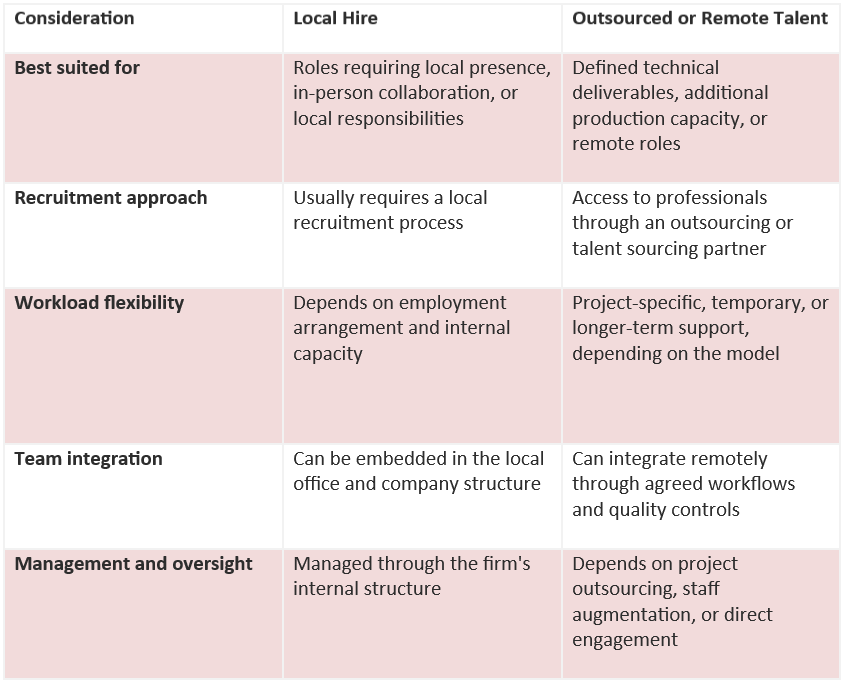
The comparison should not be reduced to salary alone. Decision makers should consider the total cost of obtaining the required capacity, including recruitment, onboarding, management time, delivery requirements, and the financial impact of waiting.
For some roles, a local hire is the right choice. For others, remote professionals or outsourced technical services may provide a practical way to maintain delivery capacity while recruitment continues. The strongest approach is often a combination of local leadership and flexible technical support.
How to Calculate the Cost of an Unfilled Position
Before deciding how to address a vacancy, estimate the business impact of leaving the role unfilled. A useful starting point is to assess five areas.
- Recruitment and onboarding costs: Include advertising, recruitment agency fees where applicable, interviewing time, and onboarding expenses.
- Lost productive capacity: Estimate work that cannot be completed because the position is vacant, including delayed deliverables and reassigned work.
- Lost revenue opportunities: Identify tenders not pursued, proposals delayed, and additional work declined because the team lacks capacity.
- Additional workload costs: Account for overtime, temporary support, and senior employees covering responsibilities outside their primary roles.
- Project and margin exposure: Review the potential financial impact of schedule slippage, extended overhead, rework, missed variations, and delayed billing.
Assess these figures carefully to avoid double-counting the same loss. For example, a delayed deliverable and its associated extended overhead may be related costs rather than separate, independent losses. The purpose is to establish a realistic picture of the vacancy's impact, not to assign a speculative price to every missed opportunity.
ADDMORE Services provides a cost savings calculator to help firms examine potential savings and the financial implications of their staffing decisions.
How to Choose the Right Outsourcing Partner
Access to remote talent is only valuable when the arrangement supports the firm's technical requirements and delivery standards. Before engaging an outsourcing partner, consider the following:
- Technical capability: Experience with the required disciplines, software, documentation standards, and project deliverables.
- Quality assurance: Defined review processes and quality controls to support accuracy and consistency.
- Workflow integration: Ability to work within established systems, communication practices, and project management processes.
- Scalability: Capacity to accommodate changing workloads, specialist requirements, and longer-term needs.
- Clear accountability: Defined deliverables, responsibilities, review procedures, and communication expectations.
- Engagement structure: Whether project-specific outsourcing, staff augmentation, embedded talent, or direct sourcing best fits the requirement.
- Time zone alignment: A working arrangement that supports timely communication, coordination, and review.
A well-structured outsourcing arrangement should provide more than additional hands. It should establish a clear connection between the required work, the professionals performing it, and the standards expected by the client.
How ADDMORE Services Helps AEC Firms Maintain Delivery Capacity
ADDMORE Services LLC supports architecture, engineering, construction, and development firms with project-specific outsourcing, professional talent outsourcing, remote talent sourcing, and consultancy services.
Headquartered in Las Vegas, Nevada, ADDMORE operates talent hubs across the Philippines, Latin America, South Africa, India, and Sri Lanka, supporting clients in the United States, Australia, the United Kingdom, the Republic of Ireland, the United Arab Emirates, and the Kingdom of Saudi Arabia.
- Architectural Drawings, BIM, and Renderings: Architectural CAD drafting, construction documentation, BIM and 3D modelling, visualization, and shop drawings.
- Quantity Takeoffs and Cost Management: Quantity surveying, construction cost estimating, and cost management support.
- Project Management and FF&E Sourcing: Project coordination, project management, feasibility support, and furniture, fixtures, and equipment sourcing.
- MEP and Structural Services: MEP BIM, drafting, coordination, shop drawings, structural BIM, steel detailing, precast detailing, and rebar detailing.
- F&B Hospitality Design Support: Food service planning, hospitality design support, project management, and related consultancy through ADDMORE's specialist partners.
Firms can engage ADDMORE for defined project deliverables or access professional talent to support ongoing team requirements. The appropriate service depends on the work required, the duration of the need, and how the client wants the engagement structured.
Founded by Colin Anthony Addley, a Chartered Builder, Quantity Surveyor, and Construction Manager with more than 50 years of construction industry experience, ADDMORE is built around technical capability, quality control, and collaborative delivery.
The objective is straightforward: help clients strengthen project delivery with cost-effective technical support that integrates with their existing operations.
ADDMORE is not just a service provider. It is part of your delivery model.
Build a More Resilient AEC Delivery Model
A talent gap may begin as a recruitment issue, but its effects can spread across project schedules, tender capacity, cost control, senior management workloads, and employee retention.
Local recruitment remains an essential part of building a strong team. However, relying on recruitment alone can leave firms exposed when critical roles remain unfilled or project workloads increase unexpectedly.
Project-specific outsourcing, professional talent outsourcing, and remote talent sourcing offer different ways to address those gaps, depending on the work and the engagement required.
The first step is to understand the cost of waiting. The next is to determine which responsibilities must be covered, how quickly additional capacity is needed, and what arrangement will best support delivery.
Do not let a talent gap become a bottleneck across your entire project portfolio.
Explore ADDMORE Services' professional and technical outsourcing solutions or use the cost savings calculator to start evaluating your options.