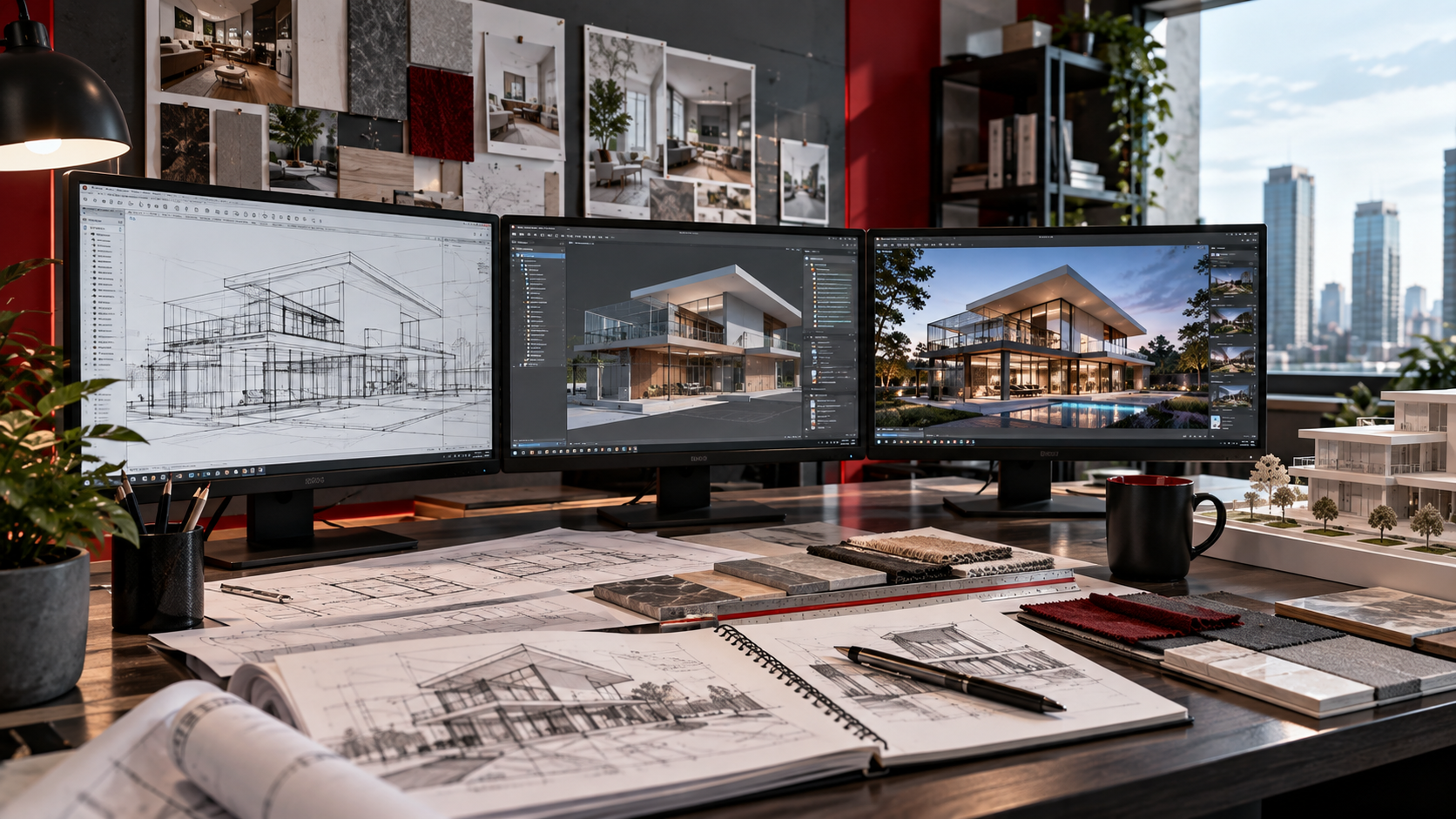
Architecture Before CAD and BIM: Design in the Analog Era
What Modern AEC Firms Can Learn from Pre-Digital Architectural Practice
Before the Cloud, There Was Craft
Imagine designing an entire building without a computer — no undo button, no parametric modeling, no instant revisions. Just pencils, ink, tracing paper, and patience.
Before CAD and BIM transformed the architecture, engineering, and construction (AEC) industry, architecture was fundamentally tactile. Ideas were explored through the movement of the hand, refined through physical models, and documented through painstaking manual drafting.
While digital tools now dominate project delivery, the analog era established the intellectual rigor, visual language, and craftsmanship that still underpin modern practice. Understanding this history is more than nostalgia — it reveals why thoughtful design processes matter even in today’s high-speed environment.
Drawing Boards and Drafting Tools: Where Designs Were Born
Before digital drafting software, the drawing board was the architect’s command center. Every concept — from initial layout to final construction documents — emerged from this physical workspace.
Core tools included:
- Graphite pencils and technical pens
- T-squares and drafting triangles
- Scales, compasses, and templates
- Layers of tracing paper for iterative refinement
Each revision required redrawing affected portions of the project. Mistakes were costly in time and effort, encouraging precision and forethought. Line weights, hatching, and graphic conventions functioned as standardized technical language, communicating materials, depth, and construction intent.
The process was not just mechanical — it was cognitive. Architects quite literally thought through drawing.
Concept Development Through Sketching
Freehand sketches formed the earliest stage of design exploration. These rapid drawings allowed architects to test form, proportion, circulation, and narrative intent without committing to precise documentation.
Sketching enabled:
- Fast iteration of ideas
- Exploration of spatial relationships
- Communication with clients and teams
- Development of a cohesive design concept
Even today, many leading firms begin projects with hand sketches before transitioning into digital workflows — a testament to the enduring power of analog ideation.
Physical Models: Understanding Space Before Screens
Before 3D software and real-time visualization, architects relied on physical models to evaluate spatial qualities.
Constructed from materials such as foam board, wood, or cardboard, these models helped designers:
- Test massing and proportions
- Study light and shadow
- Evaluate circulation patterns
- Communicate ideas to non-technical stakeholders
Physical models translated abstract drawings into tangible form, bridging the gap between concept and reality.
Producing Construction Documents Without CAD
Documentation was the most labor-intensive phase of analog architecture. Plans, sections, elevations, and details were drafted entirely by hand on large sheets.
Key characteristics of manual documentation included:
- Careful composition and dimensioning
- Ink drawings that were difficult to correct
- Extensive use of overlays for coordination
- Blueprint reproduction for distribution
Updating drawings often meant recreating entire sheets, reinforcing the need for accuracy before committing to ink. Despite these constraints, hand drawings possessed a distinctive expressive quality and craftsmanship rarely seen in purely digital outputs.
Limitations — and Unexpected Advantages — of Analog Workflows
Analog processes imposed significant constraints:
Challenges
- Slow iteration cycles
- Labor-intensive production
- Limited remote collaboration
- Large physical storage requirements
- Higher risk of costly errors
Advantages
- Deep attention to detail
- Strong design discipline
- Thorough exploration before decisions
- Intuitive understanding of construction
- Meaningful connection between drawing and building
Because revisions required significant effort, architects developed a habit of deliberate decision-making. The slower pace fostered thoughtful, highly resolved designs.
How Analog Methods Still Influence Modern Architecture
Even in the BIM era, analog techniques remain foundational.
- Hand drawing trains designers to evaluate proportion and composition carefully
- Early sketches help establish clear concepts before digital development
- Physical model-making builds spatial awareness and craftsmanship
Architectural education continues to emphasize these skills because they cultivate critical thinking and design intuition that software alone cannot provide.
From Analog Craft to Digital Delivery
Today’s AEC firms operate in a vastly different environment — fast-paced, highly coordinated, and data-driven. Yet the core challenge remains the same: transforming ideas into buildable reality efficiently and accurately.
Modern digital workflows now combine conceptual creativity with production scalability. Many successful firms augment their internal teams with external technical expertise — particularly for drafting, BIM modeling, and visualization — to maintain speed without sacrificing quality.
ADDMORE Services LLC supports this evolution through specialized Architectural, BIM & Rendering Services, delivered by skilled offshore professionals who integrate seamlessly with your project teams.
Rather than replacing design leadership, this approach strengthens it — enabling firms to focus on innovation while experienced production teams handle labor-intensive technical tasks.
Services typically include:
- Architectural drafting and documentation
- BIM modeling and coordination
- 3D visualization and rendering
- As-built and construction drawing support
- Project lifecycle technical services
This mirrors the collaborative studio model of the analog era — but enhanced by global connectivity, digital precision, and scalable capacity.
👉 Learn more about these solutions here:
Architectural, BIM & Rendering Services
https://www.addmoreservices.com/architectural--bim---rendering-services
Why the Analog Era Still Matters Today
Pre-digital architecture cultivated qualities that remain essential for successful project delivery:
- Intentional decision-making
- Craftsmanship and clarity
- Deep spatial understanding
- Respect for constructability
- Human-centered design thinking
Digital tools have accelerated workflows, but they did not replace the need for thoughtful design. In fact, the most effective firms combine analog wisdom with modern technology — achieving both creativity and efficiency.
Ready to Optimize Your Project Delivery?
If your firm is looking to scale production, reduce costs, or accelerate timelines without compromising quality, intelligent resourcing can make a measurable difference.
👉 Try ADDMORE’s Cost Savings Calculator to estimate how offshore support could benefit your projects:
https://www.addmoreservices.com/cost-calculator
Or contact ADDMORE Services LLC for a free consultation to explore how tailored Architectural, BIM, and Rendering support can strengthen your delivery pipeline — while keeping your core team focused on high-value design work.