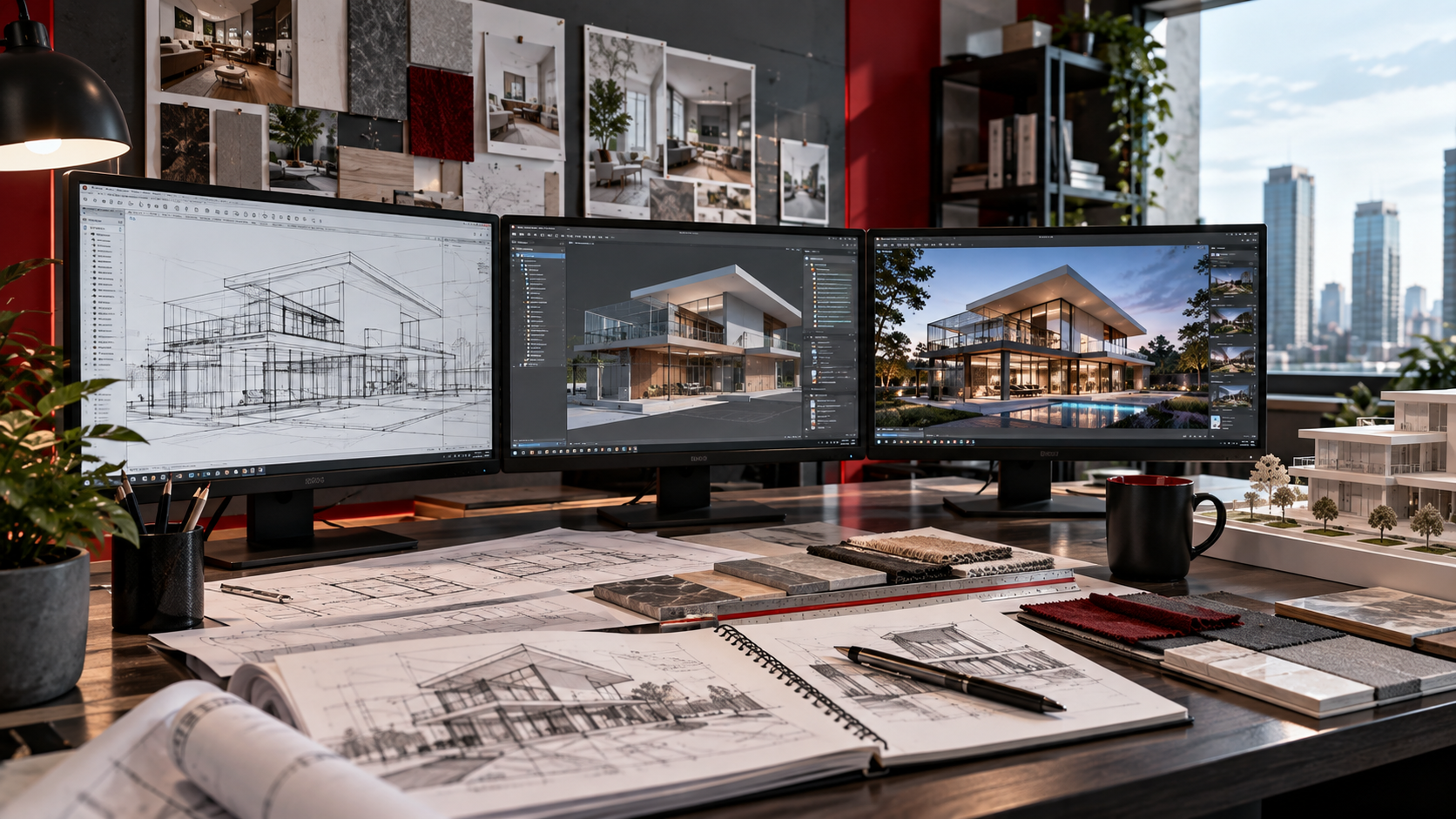
Ways Architectural Drafting Services Can Help Make a Building Project Successful

Joel Phillips • January 1, 2000

Ways Architectural Drafting Services Can Help Make a Building Project Successful

Business owners from various industries worldwide are turning to offshore and outsourcing solutions to reap the many benefits offered by the two, including access to high-level expertise, accuracy, and cost-efficiency.

Premier outsourcing companies like ADDMORE Services  play a vital role in ensuring their projects are completed the way they were conceptualized. The set of drawings and other documentation prepared by our team is of utmost importance for industry professionals and their clients. Before we head on to the ways our architectural drafting experts can add value to your project, let's briefly learn what architectural drawings are.

Architectural Drawings: What Do They Entail?

Architectural drawings refer to the basic technical drafts that show a building's structure in detail. Lines, characters, and symbols are used to represent different building elements and features graphically. All graphics follow certain measuring scales to standardize the details in the overall drawings used frequently for designing, architecture, and construction purposes.

These drawings are incredibly useful when created in high quality with accuracy. Our experts can help develop precise drawings that will help make the entire process from the initial phase to the end-stage much more systematic. The architectural drafting team provides the final form of the conceptualized design to ensure there is no room for confusion or misinterpretation during the project's construction stage.  

These drawings are also helpful for contractors as they provide an accurate idea about several things, including materials and other requirements that need to be streamlined for successful project completion. It gives them a near-perfect idea about the overall estimation and budget that needs to be dedicated to the project.

Moreover, the drawings show the space's design to give an idea of how it will appear upon completion. Hence, they are quite helpful in turning the interest of potential buyers. New-age AutoCAD software used by professionals at ADDMORE Services has made documentation and drafting much quicker, more convenient, and more accurate than when things were done manually. Incorporating changes when dealing with complex structures and multiple layers is also fairly easier ever since. Now let's look at some ways architectural drawing outsourcing helps make life easier for AEC professionals worldwide.

@font-face{<br />font-family:"Times New Roman";<br />}@font-face{<br />font-family:"宋体";<br />}@font-face{<br />font-family:"Calibri";<br />}@font-face{<br />font-family:"Calibri Light";<br />}@font-face{<br />font-family:"等线 Light";<br />}p.MsoNormal{<br />mso-style-name:Normal;<br />mso-style-parent:"";<br />margin-bottom:2.0000pt;<br />font-family:Calibri;<br />mso-bidi-font-family:'Times New Roman';<br />font-size:12.0000pt;<br />}h1{<br />mso-style-name:"Heading 1";<br />mso-style-next:Normal;<br />margin-top:12.0000pt;<br />margin-bottom:0.0000pt;<br />page-break-after:avoid;<br />mso-pagination:lines-together;<br />mso-outline-level:1;<br />font-family:'Calibri Light';<br />mso-fareast-font-family:'等线 Light';<br />mso-bidi-font-family:'Times New Roman';<br />color:rgb(47,84,150);<br />font-size:16.0000pt;<br />}p.MsoHeader{<br />mso-style-name:Header;<br />mso-style-noshow:yes;<br />margin-bottom:0.0000pt;<br />font-family:Calibri;<br />mso-bidi-font-family:'Times New Roman';<br />font-size:12.0000pt;<br />}p.MsoFooter{<br />mso-style-name:Footer;<br />mso-style-noshow:yes;<br />margin-bottom:0.0000pt;<br />font-family:Calibri;<br />mso-bidi-font-family:'Times New Roman';<br />font-size:12.0000pt;<br />}span.msoIns{<br />mso-style-type:export-only;<br />mso-style-name:"";<br />text-decoration:underline;<br />text-underline:single;<br />color:blue;<br />}span.msoDel{<br />mso-style-type:export-only;<br />mso-style-name:"";<br />text-decoration:line-through;<br />color:red;<br />}div.Section0{page:Section0;}

#1- Access to Skilled Architectural Drafters

By outsourcing the job to us, you can enjoy the flexibility of building your optimum team as we help you cherry-pick from the vast pool of highly talented resources that have partnered with ADDMMORE Services from all over the globe. Every expert possesses years' worth of experience in generating high-quality architectural models with the capability to create bills of materials and edit or produce flawless isometrics.

@font-face{<br /> font-family:"Times New Roman";<br /> }@font-face{<br /> font-family:"宋体";<br /> }@font-face{<br /> font-family:"Calibri";<br /> }@font-face{<br /> font-family:"Calibri Light";<br /> }@font-face{<br /> font-family:"等线 Light";<br /> }p.MsoNormal{<br /> mso-style-name:Normal;<br /> mso-style-parent:"";<br /> margin-bottom:2.0000pt;<br /> font-family:Calibri;<br /> mso-bidi-font-family:'Times New Roman';<br /> font-size:12.0000pt;<br /> }h1{<br /> mso-style-name:"Heading 1";<br /> mso-style-next:Normal;<br /> margin-top:12.0000pt;<br /> margin-bottom:0.0000pt;<br /> page-break-after:avoid;<br /> mso-pagination:lines-together;<br /> mso-outline-level:1;<br /> font-family:'Calibri Light';<br /> mso-fareast-font-family:'等线 Light';<br /> mso-bidi-font-family:'Times New Roman';<br /> color:rgb(47,84,150);<br /> font-size:16.0000pt;<br /> }p.MsoHeader{<br /> mso-style-name:Header;<br /> mso-style-noshow:yes;<br /> margin-bottom:0.0000pt;<br /> font-family:Calibri;<br /> mso-bidi-font-family:'Times New Roman';<br /> font-size:12.0000pt;<br /> }p.MsoFooter{<br /> mso-style-name:Footer;<br /> mso-style-noshow:yes;<br /> margin-bottom:0.0000pt;<br /> font-family:Calibri;<br /> mso-bidi-font-family:'Times New Roman';<br /> font-size:12.0000pt;<br /> }span.msoIns{<br /> mso-style-type:export-only;<br /> mso-style-name:"";<br /> text-decoration:underline;<br /> text-underline:single;<br /> color:blue;<br /> }span.msoDel{<br /> mso-style-type:export-only;<br /> mso-style-name:"";<br /> text-decoration:line-through;<br /> color:red;<br /> }div.Section0{page:Section0;}

#2- Flexible Engagement Models

When you work with us after seeing our proven track record, you can be assured of all kinds of support you need to succeed. Our engagement models are flexible, meaning they can be tailored to meet your schedule and requirements. From time and material to fixed-price, or even hybrid models, we offer completely customized solutions to clients worldwide, including but not limited to the UK, the Republic of Ireland, Australia, New Zealand, the USA, and the Middle East.

@font-face{ font-family:"Times New Roman"; }@font-face{ font-family:"宋体"; }@font-face{ font-family:"Calibri"; }@font-face{ font-family:"Calibri Light"; }@font-face{ font-family:"等线 Light"; }p.MsoNormal{ mso-style-name:Normal; mso-style-parent:""; margin-bottom:2.0000pt; font-family:Calibri; mso-bidi-font-family:'Times New Roman'; font-size:12.0000pt; }h1{ mso-style-name:"Heading 1"; mso-style-next:Normal; margin-top:12.0000pt; margin-bottom:0.0000pt; page-break-after:avoid; mso-pagination:lines-together; mso-outline-level:1; font-family:'Calibri Light'; mso-fareast-font-family:'等线 Light'; mso-bidi-font-family:'Times New Roman'; color:rgb(47,84,150); font-size:16.0000pt; }p.MsoHeader{ mso-style-name:Header; mso-style-noshow:yes; margin-bottom:0.0000pt; font-family:Calibri; mso-bidi-font-family:'Times New Roman'; font-size:12.0000pt; }p.MsoFooter{ mso-style-name:Footer; mso-style-noshow:yes; margin-bottom:0.0000pt; font-family:Calibri; mso-bidi-font-family:'Times New Roman'; font-size:12.0000pt; }span.msoIns{ mso-style-type:export-only; mso-style-name:""; text-decoration:underline; text-underline:single; color:blue; }span.msoDel{ mso-style-type:export-only; mso-style-name:""; text-decoration:line-through; color:red; }div.Section0{page:Section0;}

#3- Increased Cost Efficiency

Hiring specialists with relevant expertise and industry experience gives you the benefit of smart and innovative solutions for creatively dealing with the real-world complexities of engineering and designing. This means our professionals use not only the recommended practices and software tools but also think out of the box to deliver smart solutions to increase overall design efficiency and productivity.

#4- Reference for Future Projects

Thoroughly prepared architectural drawing sets and documents prove incredibly beneficial when handling similar nature projects in the future. They help save time and resources as one can simply consult the previous documents to get an idea of the interior arrangements, construction details, specifications, types of material, and so on.

#5- Compliance with International Standards and Codes

AEC industry professionals are always at the risk of facing legal issues. However, proper documentation can help them if a dispute arises with the client over the responsibilities associated with the community or the building itself. Thoroughly prepared documents by our experts can not only help avoid costly lawsuits but also ensure accuracy, which is paramount for structures. Our experts are well-versed and stay updated with the international design standards and codes like DIN , ANSI, JIS , ASME, and so on to ensure you get compliant, reliable solutions every time.

Get competent BPO  services to streamline cost savings by partnering with ADDMORE Services. As a dependable vendor, we have got a range of creative solutions to boost the productivity and efficiency of your AEC projects. Not only do we guarantee top-notch quality with quick turnaround times, but we also promise our services will ADD MORE value to your projects.

We have got you covered for a wide range of BPO services, offshoring , and outsourcing  solutions, including BIM modeling solutions, CAD drafting services, construction project management, Revit design services, construction cost services, takeoff estimating services, contract administration, quantity surveying services, architectural drafting services, Primavera modeling services, and more . We can also help you connect to virtual assistants or leased staff with loads of experience supporting multiple clients across various industries .

Reach out to us  right away to pick the right cost-efficient package  from our multiple engagement models.  

August 24, 2026
Artificial intelligence has arrived in the built environment without much of an announcement. It is in the modelling software, in the document management platform, in the take-off tool, and in the email client. Most architecture and interior design practices are already using it several times a day, whether anyone has written a policy about it or not. So, the interesting question is no longer whether to use AI. It is what happens to the work once you do. The part of the story that gets left out Read almost anything written about AI and outsourcing this year and you will find the same quiet admission underneath the enthusiasm: none of it runs on its own. Somebody must prepare the information the system learns from. Somebody must look at what comes out the other end and decide whether it is right. The technology is genuinely impressive. It is also unaccountable on its own. That matters more in our sector than in most. A chatbot that answers a customer badly is an irritation. A model that produces a clash-free-looking coordination report on a badly set up federated model, or a take-off that quietly omits a whole material line, is a cost that lands on site months later, when it is expensive to fix and difficult to argue about. AI is very good at producing work that looks finished. Judging whether it is finished is a different skill, and it is not a technical one. It comes from having drawn the detail before, having priced the package before, having been on the receiving end of the RFI when it went wrong. What this looks like on a real project A Revit technician who understands how a model is meant to be structured can use automation to strip hours out of repetitive family creation, sheet setup and annotation, and spend the recovered time on the parts that need thought. A technician who does not understand the model will use the same tools to produce a great deal of tidy-looking rubbish, very quickly. An estimator with fifteen years behind them can run an automated material take-off, scan the output and know within a minute that the ceiling quantities are wrong because the tool has read a plenum as a room. The software will not flag that. Nothing in the output will look unusual. The estimator knows because they have seen a plenum before. The same holds for shop drawings, submittal review, document registers and coordination. In each case, the tool moves faster than a person could. In each case, someone must own the answer. What to actually look for If AI raises the value of judgement rather than lowering it, then the way firms buy resource ought to change with it. A few things are worth asking of anyone providing you with people: Can they scale up and down at the pace your workload genuinely moves, rather than at the pace of a twelve-month commitment? Do you know what you are paying and what you are getting for it, without unpicking a rate card? Do the people they provide work inside your systems, your file structure and your standards, or alongside them? And when something is wrong, is there a named person who is accountable for it? None of those questions mention AI. That is rather the point. The tools will keep changing. What protects the project is the quality of the person using them and the clarity of who answers for the output. Where ADDMORE sits We are not an AI company in the way that phrase is usually meant. We did not build a model and then go looking for somewhere to point it. We started from the work of documenting buildings, pricing packages and keeping projects moving, and everything we have built since has come out of that. What we provide is people, and the technology those people need to do the work properly. That means qualified back office professionals: 3D modellers, Revit and AutoCAD technicians, US estimators and document controllers, working as an extension of your own office, on your systems and to your standards. It also means business technology support: data engineers, analysts, BI specialists and AI engineers who build and maintain the automated parts of the workflow, the take-off routines, the document pipelines, the reporting behind the reporting. Done well, you never have to think about any of it. Done badly, it is the reason a number was wrong three months ago and nobody noticed. We also build software of our own, including PromoreIQ, our AI platform. We would rather tell you what a tool can and cannot do having had to make one work ourselves. Our people use AI in their daily work, and we expect them to. What we are providing, across all of it, is the experience that sits behind the output: the person who knows what the drawing is for, what the client will ask next, and what a plausible-looking result should have said instead. That is also why we have not rushed to relabel what we do. The work has not changed as much as the vocabulary around it has. Buildings still have to be documented properly. Packages still have to be priced accurately. Somebody still has to be answerable when they are not. The short version AI has made the first draft of almost everything affordable. It has not made the judgement inexpensive, and in the built environment, the judgement is where the risk lives. The firms that get the most out of these tools over the next few years will not be the ones with the largest technology budget. They will be the ones with enough experienced people to tell good output from bad, fast enough for it to matter. If you are working out how to add that capacity without adding overhead, we would be glad to talk it through.
August 19, 2026
The Hidden Advantage of Offshore Outsourcing: Why Broader Talent Pools Lead to Better Results When businesses talk about offshore outsourcing, the conversation often starts with two familiar topics: cost savings and time zones. Both are important. But they are not what ultimately determine whether an offshore engagement delivers meaningful value. The bigger question is much more fundamental: Are you accessing the right talent in the first place? A broader talent pool, a fair approach to evaluating capability, and a genuine understanding of local professional markets can have a significant impact on the quality of offshore work. This is especially relevant for industries where technical knowledge, consistency, communication, and attention to detail directly affect project outcomes. For companies exploring offshore outsourcing, the opportunity is not simply to reduce operating costs. It is to access capabilities that can strengthen the way work gets done. Offshore Outsourcing Is About More Than Cost Cost efficiency is one of the most obvious advantages of offshore outsourcing. However, focusing exclusively on cost can lead businesses toward the wrong question. Instead of asking: "How much can we save?" It can be more valuable to ask: "What additional capability can we access?" A lower-cost resource does not automatically create a better business outcome. If the work requires excessive supervision, frequent corrections, or repeated revisions, the initial savings can quickly be offset by lost time and reduced productivity. The strongest offshore models focus on value rather than price alone. That means identifying professionals with the right technical capabilities, evaluating them against the actual requirements of the work, and creating an operating environment where those capabilities can be used effectively. A Broader Talent Pool Creates Better Opportunities One of the major advantages of offshore outsourcing is geographic access to talent. Clients that work with trusted professional and technical AEC support services who have access in regions such as the Philippines, LATAM, and other global talent hubs gain access to a wider pool of professionals with diverse educational backgrounds, varied project experience, strong technical capabilities, and broader perspectives. Organizations that achieve stronger results are not simply moving fast or chasing the lowest cost. They succeed because they tap into a broader talent landscape and use more rigorous, meaningful methods to assess capability. This is particularly important when the work requires specialized knowledge. For example, an AEC company looking for additional support with drafting, BIM production, quantity takeoffs, documentation, or other technical functions may benefit from looking beyond its immediate geographic market. The objective is not to find more people. It is to fin d more of the right capabilities. Why the Quality of Evaluation Matters Expanding the talent pool is only part of the equation. How professionals are evaluated matters just as much. Traditional hiring and sourcing processes can sometimes place too much emphasis on familiar credentials, recognizable companies, conventional career paths, or whether a candidate appears to fit a predetermined profile. These indicators can be useful, but they do not always demonstrate how well someone can actually perform the work. A more effective approach is to focus on demonstrable capability. Depending on the function, that could include evaluating: Technical knowledge Relevant industry experience Problem-solving ability Attention to detail Communication skills Ability to follow established processes Software proficiency Practical application of knowledge Ability to work independently Consistency and quality of output For technical industries, this distinction is particularly important. A professional who can demonstrate the ability to produce accurate work may ultimately provide more value than someone whose profile simply looks impressive on paper. Inclusive Evaluation Can Improve Offshore Outcomes Inclusive evaluation can meaningfully strengthen offshore outcomes. While inclusive hiring is often framed as a cultural initiative, it also carries a practical business advantage. When companies expand their talent search and assess candidates based on demonstrated capability, they open the door to a wider pool of qualified professionals, including individuals whose strengths might otherwise be overlooked. This matters even more in offshore outsourcing, where geographic reach already exposes organizations to diverse professional markets. The opportunity is to make that access count by avoiding narrow assumptions about what a strong candidate should look like. A broader talent map, paired with fair, capability‑focused evaluation, creates a stronger and more reliable foundation for offshore delivery. Local Market Understanding Makes a Difference Offshore outsourcing is not simply a matter of selecting a country and searching for available professionals. Every market has its own professional environment, educational systems, compensation expectations, talent concentrations, and working practices. Understanding those differences matters. The value of working with organizations that understand the local market rather than relying exclusively on databases or generic sourcing methods is not to be overlooked. For businesses, this can mean better alignment between the capabilities they need and their trusted intelligent resourcing anwith knowledge and access to pre-vetted professionals available in a particular location. It can also help create more realistic expectations around communication, workflows, professional development, and the type of work that can be effectively delivered offshore. The AEC Industry Has a Particularly Strong Opportunity For the architecture, engineering, and construction industry, offshore outsourcing can extend far beyond basic administrative support. AEC businesses frequently deal with fluctuating workloads, demanding project schedules, specialized documentation requirements, and resource-intensive production work. Access to a broader pool of technical professionals can provide additional capacity in areas such as: Architectural drafting BIM and Revit production Construction documentation Shop drawings Quantity takeoffs Material schedules Cost management support Rendering and visualization MEP and structural documentation Project administration The value comes from connecting these capabilities with the right workflows and quality standards. This is why the quality of the offshore professional matters just as much as the cost structure. Offshore Capability Should Complement Your Existing Operations A successful offshore model should not feel disconnected from the business it supports. The objective is to create an effective extension of existing workflows. That requires clear processes, defined deliverables, appropriate quality control, effective communication, and a shared understanding of project expectations. For an AEC organization, this might mean having offshore professionals support production documentation while project leadership, design decisions, client relationships, and critical approvals remain within the primary business. The result is not simply outsourced labor. It is additional professional capacity integrated into the way the business already operates. How ADDMORE Approaches Offshore Outsourcing At ADDMORE Services LLC, our focus is on helping AEC organizations access professional offshore capabilities Solutions that can support their technical and operational requirements. Rather than positioning offshore outsourcing purely as a cost-cutting exercise, ADDMORE approaches it as an opportunity to add specialized capability where it can create measurable value. Our offshore professionals support areas including architectural documentation, BIM and Revit production, engineering drawings, quantity takeoffs, cost management, rendering, Sales and Operations and other AEC-related services The objective is straightforward: Give AEC businesses access to capable professionals who can contribute to their existing workflows while helping them manage capacity, productivity, and project demands more effectively. This approach also reflects an important principle from the broader offshore outsourcing conversation: the quality of the result depends heavily on the quality of the people performing the work and the process used to identify and evaluate those capabilities. Rethinking the Offshore Outsourcing Conversation The offshore outsourcing conversation does not need to stop at: "How much can we save?" A more strategic conversation asks: What capabilities do we need? Where can we access those capabilities? How broad is the available talent pool? How are professionals being evaluated? Are we measuring actual ability or simply reviewing credentials? Does the offshore operation understand our industry? Can the work integrate effectively with our existing processes? Will the additional capacity improve our ability to deliver? These questions lead to a different understanding of offshore outsourcing. It becomes less about finding the cheapest option and more about expanding access to capability. The Real Advantage Is Access The hidden advantage of offshore outsourcing is not simply geographic distance or lower operating costs. It is access . Access to a broader professional market. Access to specialized skills. Access to additional production capacity. Access to different perspectives and experiences. And, when the process is designed properly, access to professionals who can contribute meaningful value to the work being delivered. For companies willing to look beyond the traditional boundaries of recruitment and resourcing, a broader talent pool can become a genuine competitive advantage. Looking to Expand Your AEC Capabilities? If your AEC business is dealing with increasing workloads, tight project deadlines, or gaps in technical production capacity, offshore outsourcing may provide a practical way to expand your capabilities without unnecessarily increasing your internal overhead. ADDMORE Services offers professional offshore outsourcing solutions designed specifically for the AEC industry. Contact us for a free consultation to discuss your current requirements and explore where offshore professional support could add value to your operations. Visit ADDMORE Services to learn more about our AEC outsourcing solutions.
August 11, 2026
Discover how early BIM coordination and clash detection help AEC teams reduce rework, protect budgets, prevent delays, and improve construction outcomes.