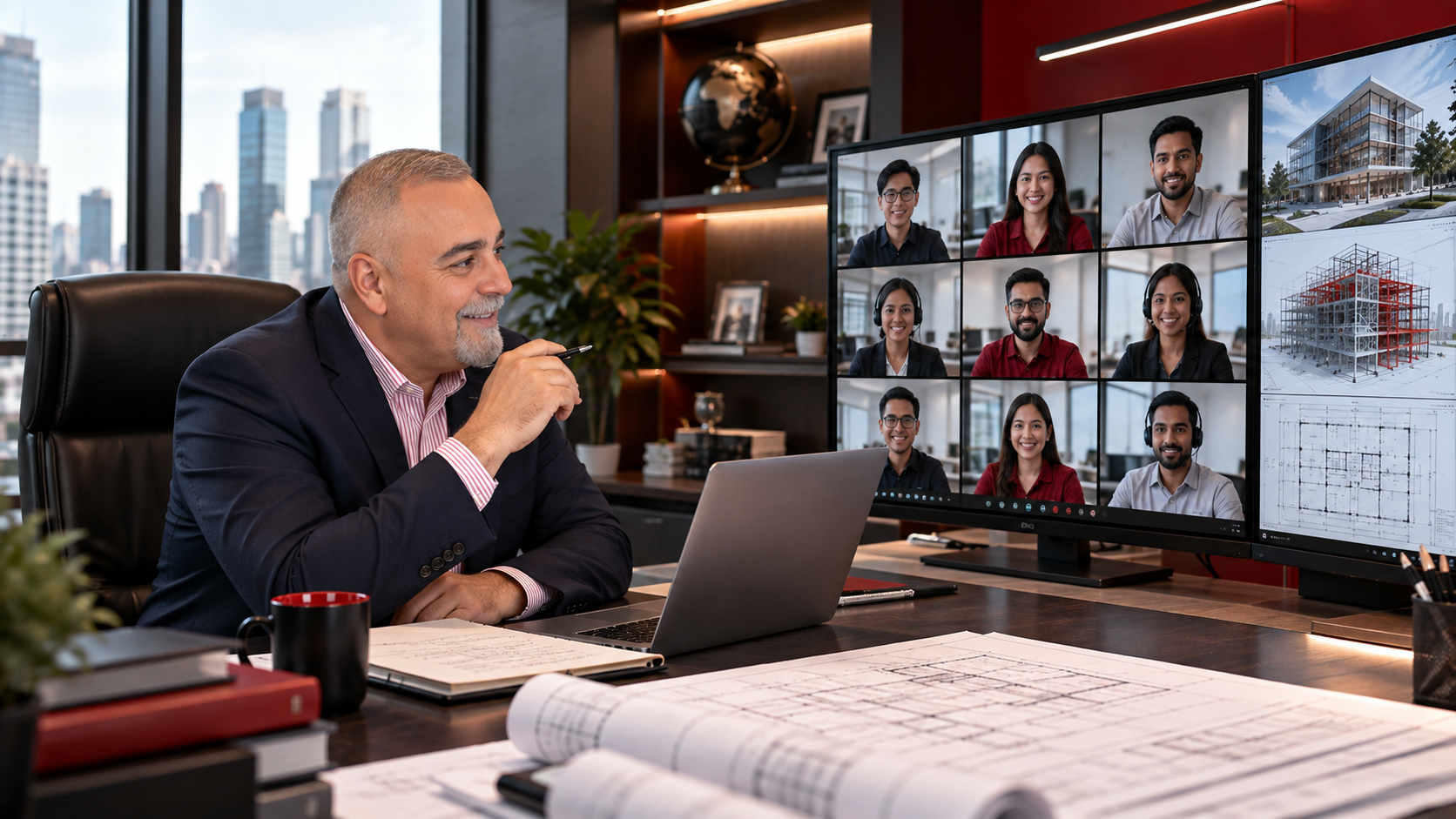
How E-Migration Is Transforming AEC Outsourcing and Global Talent
The way we work is changing. But in the Architectural, Engineering, and Construction (AEC) industry, one of the most important changes may not be happening on construction sites or inside design software. It is happening in the workforce itself.
For decades, international work was closely associated with physical relocation. Professionals moved to where the opportunities were, while companies searched for talent within the geographical boundaries of their local labor markets.
That model is no longer the only option.
Today, a skilled architect, engineer, quantity surveyor, Building Information Modeling (BIM) professional, or technical specialist can contribute directly to international projects without leaving their home country. Their expertise can cross borders even when they do not.
This emerging model, often described as e-migration, is creating a new way for professionals and companies to participate in the global economy. For the AEC industry, it presents an opportunity to rethink how talent is sourced, integrated, and deployed.
At the center of this shift is a broader concept: Intelligent Resourcing.
What Is E-Migration?
E-migration describes a modern form of global workforce participation in which professionals remain in their home countries while working directly with international organizations through remote and digitally enabled employment models.
The important distinction is simple:
The professional does not relocate. Their capability does.
A professional in Latin America, for example, can work with an AEC firm in the United States, participate in international project workflows, collaborate with colleagues in real time, and contribute to complex deliverables without physically moving to another country.
This creates a form of global talent mobility without traditional geographic displacement.
E-migration is therefore more than another way of describing outsourcing or offshoring. It represents a broader shift in how global AEC talent can participate in international projects.
For professionals, this can mean access to international careers, projects, experience, and professional development while remaining rooted in their communities.
For companies, it creates access to a much broader professional talent pool than their immediate local market can provide.
Why E-Migration Matters to the AEC Industry
The AEC industry is facing a particularly challenging workforce environment.
Project demands are increasing. Delivery timelines are becoming tighter. Clients expect greater technical precision, responsiveness, and value. At the same time, many firms face challenges related to talent availability, payroll costs, workload fluctuations, and maintaining consistent production capacity.
The result is a growing gap between what AEC firms need to deliver and what their local workforce can sustainably support.
This is where e-migration becomes particularly relevant.
Rather than limiting recruitment and resourcing to professionals available within a particular city or country, companies can access a broader international pool of qualified AEC professionals.
This can provide:
- Greater access to technical expertise
- Additional project delivery capacity
- More flexibility during periods of increased workload
- Access to professionals with international experience
- Greater cost efficiency
- Opportunities for longer-term workforce development
- Increased resilience when local talent markets are constrained
The objective is not simply to find people at lower rates.
The objective is to find the right capability for the right requirement within the right operational structure.
That is the foundation of Intelligent Resourcing.
Intelligent Resourcing: More Than a Staffing Strategy
Traditional staffing tends to focus on filling vacancies.
Intelligent Resourcing takes a broader view.
It considers how professional capability should be aligned with a company's workload, operating model, project requirements, commercial objectives, and long-term growth.
In the context of AEC outsourcing, this means looking beyond the simple transfer of tasks.
The more strategic questions are:
What capability does the business actually need?
Where can that capability be accessed?
How should those professionals integrate with the existing team?
What level of expertise is required?
How can capacity increase without unnecessarily increasing fixed overhead?
How can quality and accountability be maintained as the team expands?
These questions shift the conversation from recruitment alone to workforce design and global talent strategy.
E-migration strengthens this approach by making the international professional marketplace more accessible.
1. Broader Access to High-Calibre Professionals
E-migration opens access to professionals who may have significant experience working on international projects and with international standards.
Many professionals in emerging talent markets have advanced technical qualifications, extensive project experience, strong communication skills, and exposure to global design and construction practices.
For AEC companies, this can significantly expand the pool of available expertise.
The value is not defined by geography. It is defined by capability, experience, and the ability to contribute effectively to the project environment.
This is one of the fundamental advantages of accessing global AEC talent.
2. Cost Efficiency Through Economic Context
One of the important advantages of international talent sourcing is the difference in local economic conditions.
Professional rates can vary significantly between countries, even when the underlying capability is comparable.
This creates an opportunity for companies to achieve greater cost efficiency without automatically compromising professional standards.
The distinction is important.
Cost efficiency should come from economic context, not from reducing the quality of the work.
When structured correctly, offshore AEC services can allow firms to access professional capability at rates that are sustainable for both the business and the individual.
This makes offshore outsourcing a strategic capacity tool rather than simply a cost-cutting exercise.
E-Migration and the AEC Talent Challenge
The growing AEC talent shortage makes this shift particularly relevant.
When qualified professionals are difficult to find locally, companies have traditionally had two choices: compete harder for the same limited talent pool or delay projects and growth.
Global talent sourcing creates another option.
By expanding the geographic boundaries of recruitment and professional resourcing, AEC companies can access specialists from established talent markets across regions such as Latin America, the Philippines, South Africa, India, and Sri Lanka.
This does not eliminate the need for strong local teams.
Instead, it gives companies another layer of capability that can complement their existing workforce.
The most effective model is therefore not necessarily local versus offshore.
It can be local plus global.
The Technology Enabled the Change. People Are Driving It.
Technology has accelerated the development of global work.
Cloud platforms have made document sharing easier. Digital design tools have enabled distributed production. Building Information Modeling (BIM) has created collaborative project environments. Virtual meetings have made geographical separation less disruptive.
But technology alone does not explain the transformation.
The deeper change is human.
Professionals increasingly want access to international opportunities without necessarily relocating. Companies increasingly recognize that valuable expertise can exist far beyond their immediate geographic market.
This creates a fundamental shift in how the AEC industry thinks about talent.
The future workforce does not have to be concentrated in one location to operate as one team.
A project team can be geographically distributed while remaining operationally connected.
That is one of the most significant implications of e-migration.
What This Means for AEC Leaders
For architects, engineers, contractors, developers, and other AEC leaders, e-migration presents an opportunity to reconsider traditional workforce assumptions.
Instead of asking:
"Where can we find the people we need?"
The more strategic question becomes:
"Where can we access the capability we need, and how can we integrate it effectively into our operation?"
That change in thinking can have significant commercial implications.
A firm may not need to continuously expand its local payroll to accommodate every fluctuation in project demand. It may not need to turn away work because its internal team is at capacity. It may not need to limit its capabilities to the talent available within commuting distance of its office.
With the right operating model, international AEC professionals can become an extension of the existing organization.
This is where Intelligent Resourcing becomes particularly valuable.
The ADDMORE Approach to Intelligent Resourcing
At ADDMORE Services LLC, we believe the future of AEC resourcing should be based on capability rather than geography.
ADDMORE is a professional technical services company providing offshore outsourcing for the AEC industry, connecting companies with skilled professionals who can become an integrated extension of their project and operational teams.
The focus is not simply on supplying additional people.
It is on understanding the client's requirements, identifying the appropriate professional capability, and establishing a structure that supports quality, accountability, communication, and long-term performance.
Depending on the requirement, this can support areas such as architectural production, Building Information Modeling (BIM), engineering documentation, quantity takeoffs, cost management, project support, and other technical functions.
This approach gives AEC companies another way to access global professional capability without treating offshore outsourcing as a disconnected back-office function.
It is not about replacing the local team. It is about making the entire team more capable.
From Global Talent to Global Capability
E-migration represents a significant evolution in how professionals participate in the international economy.
For individuals, it creates the possibility of building global careers without traditional relocation.
For companies, it creates access to a much broader pool of professional capability.
For the AEC industry, it provides another way to address capacity constraints, workforce challenges, and the increasing complexity of project delivery.
But accessing global talent is only the beginning.
The real advantage comes from knowing how to deploy that talent intelligently.
The companies that benefit most will not necessarily be those that simply engage the largest international workforce. They will be the companies that build the right structures around global professionals, integrate them effectively, establish clear expectations, and treat them as genuine contributors to the organization.
That is the difference between simply outsourcing work and building an Intelligent Resourcing strategy.
The Future of AEC Outsourcing Is Global
E-migration represents more than a change in where professionals work. It represents a change in how companies think about professional capability.
The AEC industry no longer has to view talent through purely geographical boundaries.
A firm in the United States can work with an experienced professional in Latin America. An international project can bring together architects, engineers, designers, estimators, and technical specialists across multiple countries. A distributed team can collaborate through the same digital environment while contributing to a shared project outcome.
This is the evolving reality of AEC outsourcing.
The opportunity is not simply to access more people. It is to access the right global talent, integrate it effectively, and build a workforce that can adapt as project requirements change.
E-migration helps make that possible.
Intelligent Resourcing provides the framework.
And organizations that embrace both can create a more flexible, scalable, and capable approach to AEC project delivery.
The Future of AEC Resourcing Is Not Defined by Geography
The AEC industry is entering a new era of workforce mobility.
Professionals no longer need to move across borders for their careers to become international. Companies no longer need to rely exclusively on the talent available within their immediate geographic markets.
E-migration is helping connect professional capability with international demand.
Intelligent Resourcing provides the framework for making that connection practical, sustainable, and commercially valuable.
The future of AEC outsourcing and global talent will not be defined solely by where professionals live.
It will be defined by what they can contribute, how effectively they integrate, and how intelligently companies deploy their capabilities.
For businesses ready to explore what a more flexible and globally connected workforce could mean for their projects, ADDMORE Services can help assess the opportunity and identify an approach aligned with their operational needs.
Ready to Explore Intelligent Resourcing?
Whether you need additional technical capacity, access to specialized AEC professionals, or a more scalable approach to project delivery, ADDMORE Services can help you explore the possibilities of global professional capability.
Contact ADDMORE Services for a free consultation and discover how Intelligent Resourcing and offshore AEC services can support your next stage of growth.