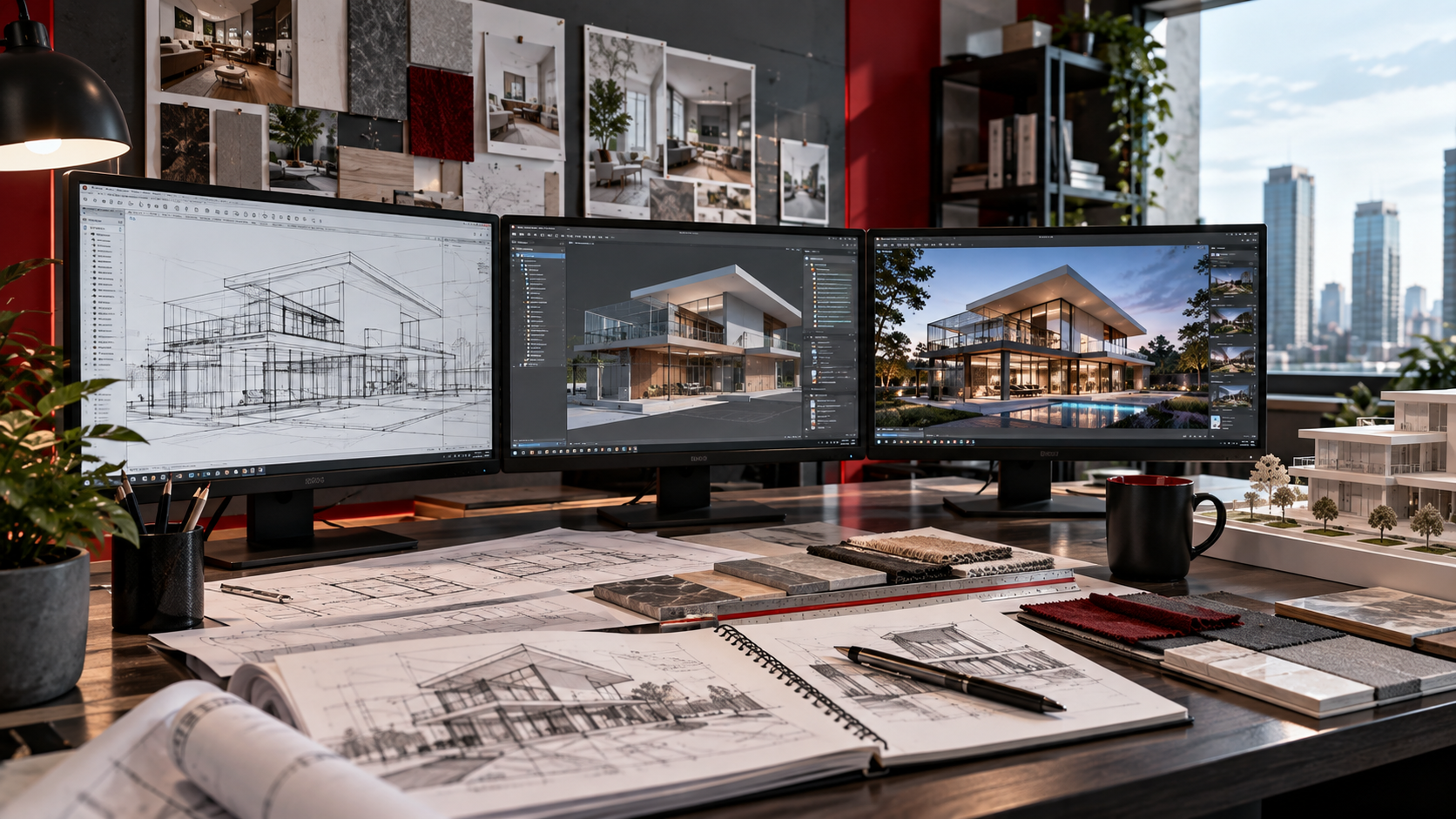
The Hidden Engine of AI in AEC: Technical Documentation, BIM & VDC Explained
Artificial intelligence is rapidly transforming the Architecture, Engineering, and Construction (AEC) industry. From generative design to automated clash detection and predictive scheduling, AI promises unprecedented efficiency and insight across the project lifecycle.
Yet behind every intelligent output lies something far less visible — and far more important.
AI systems do not create understanding from nothing. They rely on structured, high-quality data produced by skilled professionals: precise drawings, coordinated models, and disciplined documentation. Without these foundations, even the most advanced tools generate unreliable results.
In other words, before AI can revolutionize project delivery, someone must build the digital infrastructure it depends on.
This article explores why technical documentation, BIM, and Virtual Design and Construction (VDC) workflows are not outdated production tasks but the true engines powering AI-ready AEC organizations.
The AI Illusion: Technology Is Only as Good as Its Data
A common misconception is that AI will replace traditional drafting and documentation processes. In reality, AI amplifies the value of disciplined technical work rather than eliminating it.
AI systems learn from patterns embedded in project data — CAD files, BIM models, specifications, and coordinated document sets. When those inputs are inconsistent or incomplete, the outputs inherit the same flaws.
The consequences can be significant: inaccurate quantity takeoffs, misleading simulations, overlooked coordination conflicts, or design suggestions that fail in real-world conditions. The effectiveness of AI in AEC is therefore directly proportional to the quality of its underlying datasets.
Organizations that invest in structured documentation today are positioning themselves to extract meaningful value from AI tomorrow.
AutoCAD Drafting as Structured Data Creation
Architectural drafting is often viewed as a production step focused on deliverables. In an AI-enabled environment, it is more accurate to think of it as structured data creation.
Every layer, line type, block definition, and annotation contributes to a machine-readable language. When applied consistently, these standards transform drawings into datasets that support automation, analysis, and long-term reuse.
High-quality drafting establishes a framework that enables downstream technologies to function correctly. For example, standardized layer hierarchies allow automated filtering, while precise geometry ensures reliable measurements and modeling. Clean annotation systems further enhance data extraction and interoperability.
These characteristics are essential for AI-driven applications such as automated compliance checking, space planning analysis, and intelligent quantity extraction.
Forward-looking firms increasingly treat project files not as disposable outputs but as durable digital assets.
Construction Documentation as a Reliability Framework
Construction documentation is where conceptual design becomes executable instruction. It is also where data integrity is either reinforced or compromised.
AI tools depend heavily on these documents for risk assessment, scheduling, procurement planning, and cost forecasting. For such analyses to be trustworthy, documentation must be internally consistent and technically precise.
Well-executed construction documentation typically delivers:
- Coordinated drawing sets that minimize ambiguity
- Detailed information that supports constructability reviews
- Structured specifications linked to cost systems
- Version-controlled records that preserve data lineage
When documentation is fragmented, automated systems struggle to produce dependable insights. Human expertise remains essential to curate, validate, and maintain the information pipeline.
BIM and VDC as the Operational Core of AI
Building Information Modeling and Virtual Design and Construction represent the convergence of modeling, coordination, and simulation — making them the most direct interface between project data and advanced analytics.
VDC environments generate rich, multidimensional datasets that enable sophisticated capabilities such as clash detection, performance modeling, construction sequencing analysis, and safety forecasting.
Well-structured workflows produce models that are both human-usable and machine-interpretable. Key characteristics often include:
- Parametric objects with accurate properties
- Federated models enabling cross-disciplinary coordination
- Structured metadata that supports automated queries
- Simulation-ready environments for performance evaluation
The effectiveness of AI tools depends heavily on the fidelity, organization, and cleanliness of these models.
The Human Expertise Behind AI Readiness
Adopting AI is not simply a matter of installing new software. It requires organizational capabilities built on technical rigor and professional expertise.
Skilled drafters, modelers, and documentation specialists design the digital environments in which AI operates. Their work involves structuring information for accuracy, consistency, and long-term usability — not merely producing drawings.
Core competencies that support AI readiness include mastery of CAD and BIM standards, attention to geometric precision, interdisciplinary coordination skills, and commitment to documentation best practices. These capabilities become more valuable as automation increases, not less.
Documentation as Strategic Infrastructure — Not Overhead
As AI reshapes the industry, AEC firms face a strategic choice: treat documentation as a cost center or as competitive infrastructure.
Organizations that view technical documentation as foundational infrastructure are better positioned to leverage emerging technologies for efficiency, innovation, and growth. Scaling this capability internally, however, can strain resources and slow project delivery.
Specialized partners can help bridge this gap. ADDMORE Services LLC, for instance, supports AEC firms with offshore architectural drafting, construction documentation, and VDC services that function as the data backbone of modern digital practice. Their teams integrate with client workflows as an extension of in-house staff, maintaining standards and timelines while expanding capacity.
When executed effectively, this approach strengthens documentation ecosystems without sacrificing control or quality.
Building the Bridge Between Precision and Innovation
Conversations about AI often emphasize machine capabilities. A more useful perspective focuses on what human expertise must deliver to make those capabilities possible.
Every reliable AI insight begins with precise foundational work:
- Clean drawings
- Coordinated models
- Structured documentation
- Consistent standards
Together, drafting, construction documentation, BIM, and VDC create the operational platform for AI across the entire project lifecycle.
Firms that strengthen this foundation today will improve current delivery performance while unlocking future opportunities in AI-driven design, planning, and construction.
The Future of AEC: Human Expertise Amplified by AI
The future of the AEC industry is not a competition between humans and machines. It is a partnership built on precision, experience, and intelligently structured data.
Artificial intelligence magnifies the impact of disciplined technical execution. Organizations that invest in high-quality documentation, coordinated modeling, and scalable processes will gain a durable competitive advantage.
If you are exploring how offshore technical support could strengthen your documentation workflows while improving efficiency and cost control, a practical first step is to understand the potential savings.
👉
Try ADDMORE Services’ Cost Savings Calculator:
https://www.addmoreservices.com/cost-calculator