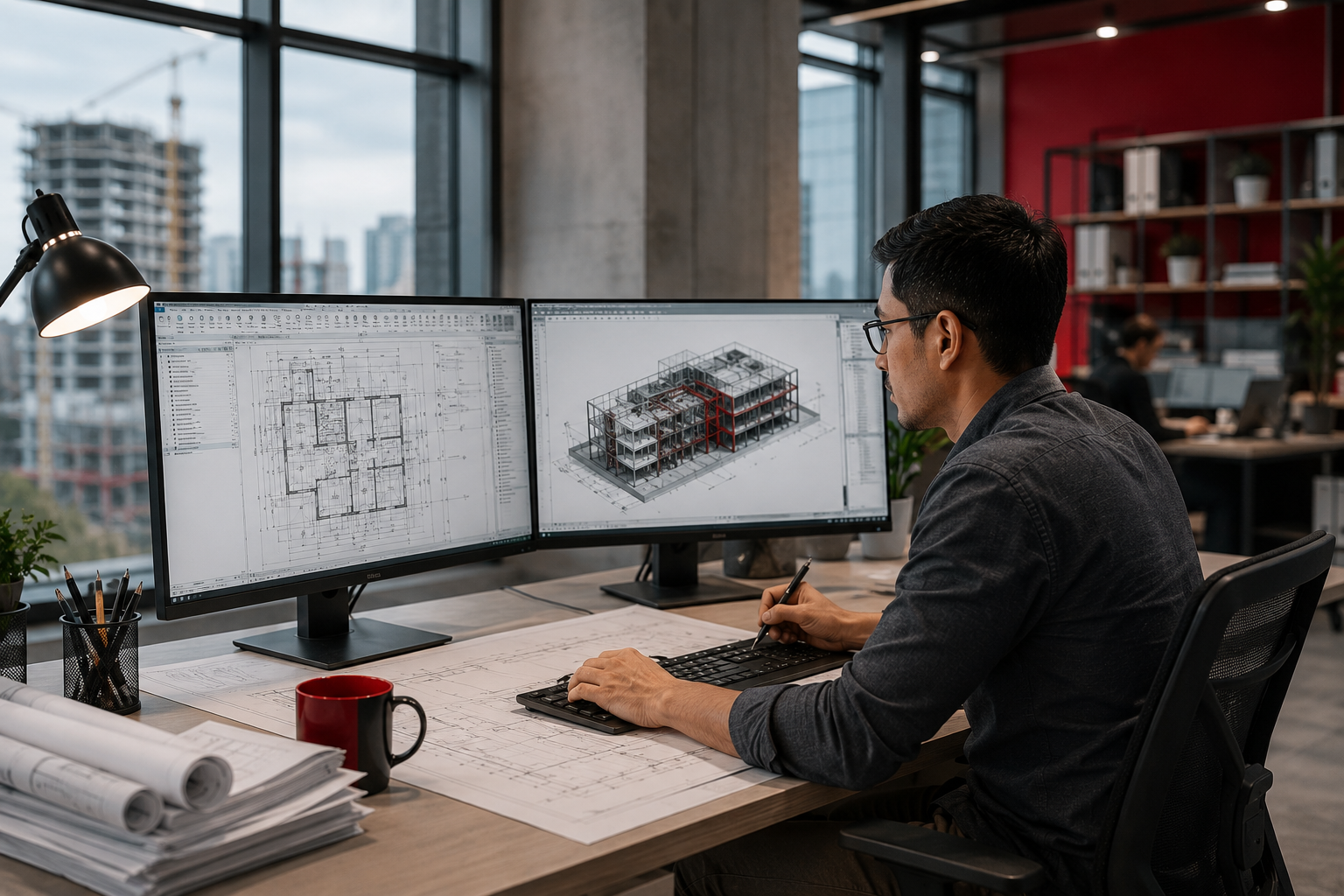
How to Decide Which AEC Roles to Outsource: Front of House vs Back of House

March 31, 2026

Growth in the AEC industry rarely slows down because of a lack of opportunity.


Opportunities are everywhere. Projects are available. Demand continues to rise across markets.


What slows firms down is something less visible but far more critical.


Growth stalls because delivery teams are stretched beyond capacity. Leadership becomes overloaded with operational demands. The internal structure of the business fails to evolve at the same pace as incoming work.


At ADDMORE, this is not a rare scenario. It is something we see consistently across firms of all sizes.


Firms win projects but struggle to execute efficiently.

Teams remain busy but productivity does not always match the level of effort.

Leaders continue to push forward, yet the operational pressure underneath continues to build.


Outsourcing, when approached correctly, is not simply about reducing cost.


It is about rebalancing how work gets done so that your business can scale with control, quality, and confidence.


Start With a Simple Truth


Not all work within an AEC firm should be treated the same way.


One of the most common structural issues in growing firms is the failure to distinguish between different types of work. Everything becomes blended into a single workflow, which creates inefficiencies and misallocation of talent.


In reality, AEC businesses operate across two distinct layers.


Front of House (Core Value Creation)


These are the roles that define your brand, shape client relationships, and directly influence revenue generation. They are strategic, high-impact, and require experience and decision-making authority.

  • Client engagement and relationship management
  • Design leadership and creative direction
  • Project leadership and decision-making
  • Business development and winning work


This is where value is created and where differentiation happens.


Back of House (Production and Support)


These roles enable delivery at scale. They are essential, but they are often process-driven and repeatable in nature.

  • AutoCAD drafting and Revit modeling
  • BIM coordination and documentation
  • Quantity take-offs and estimating support
  • Shop drawings and detailing
  • Scheduling, reporting, and administrative support


This is where efficiency is built and where scalability is achieved.


Most firms blur the line between these two layers. When that happens, highly skilled professionals spend time on low-leverage tasks, and operational inefficiencies begin to compound.


Five Questions Every AEC Leader Should Ask


Before making any outsourcing decisions, it is important to step back and evaluate how your current team operates on a daily basis.


Ask yourself the following:


  1. Are highly skilled designers spending significant time on production work?
  2. Are project leaders tied up in coordination tasks instead of leading projects?
  3. Are deadlines slipping due to documentation bottlenecks?
  4. Is your team working extended hours just to maintain current output levels?
  5. Are you turning down new projects due to limited capacity?


If the answer is yes to even two of these questions, it is a clear indication that your current structure requires adjustment.


These are not isolated issues. They are signals of a deeper resourcing imbalance.


Seven Signs It Is Time to Rebalance Your Team


You do not need a full operational audit to identify pressure points. In most cases, they are already visible in day-to-day operations.


Common signs include:

  • Design teams overloaded with drafting, revisions, and documentation tasks
  • Increasing documentation errors caused by time pressure
  • Missed deadlines or rushed deliverables
  • Inability to take on additional projects despite strong demand
  • Declining team morale or signs of burnout
  • Bottlenecks between design intent and production output
  • Rising operational costs without a corresponding increase in efficiency


These challenges are often mistaken as hiring problems.


In reality, they are resourcing problems.


Adding more people without restructuring how work is distributed will only amplify inefficiencies.


A Simple AEC Outsourcing Framework


At ADDMORE, we guide clients through a practical and structured approach to outsourcing. The goal is not to remove work from your business, but to reorganize it more intelligently.


Step 1: Map the Work

Start by breaking down what your team actually does on a daily basis. Focus on real tasks and workflows rather than job titles.


Step 2: Define Core vs Support

Core work is client-facing, design-led, and revenue-driving.

Support work is repeatable, process-driven, and production-heavy.


Step 3: Identify Bottlenecks

Examine where projects slow down. Identify where rework occurs and where delays are introduced.


Step 4: Quantify Time

Determine which tasks consume the most hours but contribute the least strategic value.


Step 5: Reassign Intelligently

Keep leadership, strategy, and creative direction in-house. Scale production and support through offshore teams that are structured and accountable.


What AEC Roles Are Ideal to Outsource?


Back of House (High Impact Outsourcing Opportunities)


These roles are structured, measurable, and highly scalable:

  • AutoCAD drafting and detailing
  • Revit modeling and BIM support
  • Shop drawings and fabrication detailing
  • Quantity take-offs and estimating support
  • FF&E documentation and coordination
  • Project scheduling and reporting
  • Data processing and administrative support


These functions benefit from process-driven workflows, clearly defined KPIs, and scalable team structures.


When executed properly, outsourcing these roles improves both speed and consistency.


Front of House (Remain Core, But Supported Better)


These roles should remain internal and client-facing, but they become significantly more effective when supported by a strong back-of-house structure:

  • Principal architects and designers
  • Project managers and client leads
  • Business development teams
  • Creative and concept design leaders


The objective is not to replace these roles.


The objective is to free them so they can operate at their highest level of value, focusing on strategy, creativity, and client relationships.


The Real Benefits of Getting This Right


When AEC firms successfully rebalance their front-of-house and back-of-house functions, the impact is immediate and measurable:

  • Increased project capacity without increasing overhead
  • Faster turnaround times for documentation and deliverables
  • Improved quality through specialized production teams
  • Reduced stress across leadership and delivery teams
  • Greater flexibility to scale operations up or down
  • More time allocated to design, client engagement, and business growth


At this stage, outsourcing is no longer viewed as a cost-saving measure.


It becomes a strategic growth enabler.


The ADDMORE Approach


At ADDMORE, we do not simply provide additional manpower.


We help firms build structured offshore capability that integrates seamlessly into their operations.


Our approach includes:


  • Dedicated teams aligned with your workflows and standards
  • POD structures with team leaders to ensure accountability
  • Clear KPIs and consistent performance tracking
  • A long-term partnership mindset focused on sustainable growth


Successful outsourcing is not about sending work elsewhere.


It is about building a smarter, more efficient system for delivering that work.


Final Thought


The AEC firms that will lead the next phase of industry growth are not those that continue to work harder under increasing pressure.


They are the ones that rethink how their teams are structured and how work flows through their organization.


They understand a fundamental principle:


Front of house creates value.

Back of house enables scale.


When this balance is properly established, the results are clear.


Your business does not just grow.


It performs with consistency. It scales with confidence. It delivers with precision.


If you are looking to build a smarter, more scalable team structure, email us at hello@addmoreservices.com to learn how ADDMORE can support your growth.


March 20, 2026
Complex building systems demand more than coordination—they require precision, integration, and foresight from the very start. Mechanical, Electrical, and Plumbing (MEP) systems are the lifelines of any structure, yet they’re also among the most prone to clashes, inefficiencies, and costly redesigns when not properly aligned. If you’ve ever dealt with site conflicts, rework delays, or misaligned systems, you already know the consequences of fragmented workflows. The good news? With the right integration of BIM and drafting processes, these challenges can be anticipated—and eliminated—long before construction begins. Let’s unpack why MEP coordination is critical, what’s at stake, and how a more integrated approach is reshaping project delivery. What is MEP Coordination—and Why It Matters MEP coordination refers to the systematic alignment of mechanical, electrical, and plumbing systems within a building design to ensure they function cohesively without spatial or operational conflicts. In traditional workflows, these systems are often designed in silos. The result? Clashes between ducts, pipes, and structural elements Inefficient routing and system overlaps Increased RFIs and change orders Costly on-site rework Modern coordination—powered by Building Information Modeling (BIM)—allows all disciplines to work within a shared, data-rich environment. This ensures that every system is not only properly placed but also optimized for performance and constructability. The Real Cost of Poor Coordination When coordination is treated as an afterthought, the downstream impact is significant: 1. Construction Delays Unresolved clashes discovered on-site can halt progress and disrupt schedules. 2. Budget Overruns Rework, redesign, and material wastage drive up project costs beyond initial estimates. 3. Compromised System Performance Improper routing or spacing can reduce efficiency, accessibility, and long-term maintainability. 4. Stakeholder Friction Misalignment between design teams, contractors, and consultants often leads to communication breakdowns. Simply put, poor coordination doesn’t just affect drawings—it affects the entire project lifecycle. The Role of Integrated BIM & Drafting An integrated approach combines BIM modeling with precise drafting workflows to create a seamless coordination ecosystem. Key Capabilities Include: Clash Detection & Resolution Identifying and resolving conflicts before construction begins using coordinated 3D models. Multi-Disciplinary Collaboration Architects, engineers, and contractors working within a unified environment. Accurate Shop Drawings Translating coordinated models into build-ready documentation. Data-Driven Decision Making Leveraging model intelligence for better planning, sequencing, and execution. This integration bridges the gap between design intent and construction reality. From Coordination to Optimization The true value of BIM-enabled coordination isn’t just avoiding problems—it’s unlocking better outcomes. Improved Efficiency Optimized routing reduces material usage and installation time. Enhanced Buildability Constructability is embedded into the design, minimizing surprises on-site. Lifecycle Value Well-coordinated systems are easier to maintain, upgrade, and operate over time. Risk Mitigation Early issue detection significantly lowers project risk exposure. Where Expertise Makes the Difference Technology alone doesn’t guarantee success—execution does. Effective MEP coordination requires: Deep technical understanding of building systems Experience across diverse project types Precision in drafting and documentation Strong communication across stakeholders This is where partnering with the right team becomes critical. At ADDMORE Services LLC , we support global AEC firms with integrated BIM and drafting solutions designed to enhance coordination accuracy and project efficiency. Our offshore delivery model enables clients to scale resources while maintaining high technical standards—without the overhead. Rather than replacing in-house teams, we function as an extension—bringing consistency, speed, and technical depth to every project phase. Best Practices for Effective MEP Coordination To maximize outcomes, leading firms adopt the following strategies: Start Early Integrate coordination during the design development phase—not after. Standardize Workflows Use consistent modeling and documentation standards across disciplines. Prioritize Communication Regular coordination meetings and model reviews are essential. Leverage the Right Tools Platforms like Autodesk Revit and Navisworks enable real-time collaboration and clash detection. Partner Strategically Augment internal capabilities with specialized teams when needed. The Future of MEP Coordination As projects grow more complex and timelines tighter, integrated BIM workflows will continue to evolve from coordination tools into full-scale project intelligence platforms. We’re moving toward: Real-time model collaboration across global teams AI-assisted clash detection and optimization Digital twins for lifecycle management Greater reliance on offshore technical expertise for scalability The firms that adapt early will gain a decisive competitive edge. Conclusion MEP coordination is no longer just about avoiding clashes—it’s about enabling smarter, faster, and more efficient project delivery. By combining BIM technology with expert drafting and a collaborative mindset, AEC firms can transform coordination from a reactive process into a strategic advantage. Ready to Improve Your Project Coordination? If you're looking to enhance your MEP workflows, reduce rework, and deliver projects with greater confidence, ADDMORE Services LLC is here to help. We offer tailored BIM and drafting solutions that integrate seamlessly with your existing processes—giving you the flexibility to scale without compromising quality. 👉 Contact us today for a free consultation and discover how we can support your next project. 
March 12, 2026
Precast and modular construction are changing how modern buildings are delivered. From warehouses and logistics hubs to data centers and industrial facilities, off-site construction offers compelling advantages—faster timelines, predictable quality, and better cost control. However, behind every successful precast project lies something far less visible: precision in structural detailing and shop drawings. When structural elements are manufactured off-site, there is little room for interpretation once construction begins. Every embed plate, rebar placement, connection, and tolerance must already be defined before fabrication starts. The difference between smooth installation and costly delays often comes down to the quality and accuracy of the documentation. In precast construction, precision on paper becomes productivity on site. This is why structural detailing and shop drawings are not simply technical deliverables—they are the foundation that allows off-site construction to function efficiently. Why Precast Construction Requires Greater Precision Traditional cast-in-place construction provides some flexibility during installation. Adjustments can often be made on-site if unexpected conditions arise. Precast construction works differently. Structural components are fabricated in controlled manufacturing facilities and delivered to the project site ready for installation. By the time these components arrive, the design must already define critical details such as: Structural dimensions and geometry Connection points between elements Reinforcement layouts and rebar schedules Embedded plates, inserts, and anchors Lifting hardware and handling requirements Installation tolerances and erection sequences If any of these elements are incorrect or poorly coordinated, the result can be fabrication rework, delayed installation, or costly field modifications. For this reason, successful precast construction depends heavily on clear, coordinated, and highly accurate documentation. The Role of Structural Detailing in Precast Projects Structural detailing converts engineering intent into fabrication-ready instructions. It acts as the bridge between structural design and the manufacturing process. In precast projects, detailing typically involves defining the precise geometry and reinforcement requirements of each structural element, including beams, columns, panels, slabs, and stair units. These details must account for structural loads, reinforcement placement, connection hardware, and the specific fabrication methods used by the precast manufacturer. Rebar detailing is another essential component. Reinforcement must be configured in a way that satisfies engineering requirements while remaining practical for fabrication and installation. Poorly detailed reinforcement can create congestion, fabrication challenges, or installation issues. Connection detailing is equally critical. Precast systems rely on carefully designed connections to transfer loads safely between components. These connections must be accurately detailed so that alignment, welding, bolting, and tolerances all work together during installation. Without clear structural detailing, even small errors can create significant problems once fabrication begins. Why Shop Drawings Are Essential While structural detailing defines how components are designed, shop drawings translate those designs into actionable fabrication and installation instructions . Shop drawings are used by multiple stakeholders across the project lifecycle. For fabricators, shop drawings provide precise information needed to manufacture each component. These drawings define dimensions, reinforcement layouts, embed locations, material specifications, and fabrication tolerances. Contractors and erection teams rely on shop drawings to coordinate installation. The drawings help clarify how components fit together, where connections occur, and how elements should be assembled in sequence. Engineers and consultants review shop drawings as part of the approval process to confirm that fabrication aligns with structural intent and project requirements. When shop drawings are prepared carefully, they remove ambiguity from the construction process and allow fabrication and installation teams to work with confidence. Coordination: The Hidden Complexity of Precast Construction One of the most overlooked challenges in precast construction is coordination between multiple building systems. Precast structural components must integrate with structural steel, mechanical and electrical systems, architectural facades, and foundation elements. Even small coordination issues can create conflicts that affect fabrication or installation. Modern workflows increasingly rely on Building Information Modeling (BIM) to address this complexity. BIM-based detailing allows teams to identify clashes, coordinate embeds and openings, and validate clearances before fabrication begins. Early coordination significantly reduces risk during the manufacturing and erection phases of the project. How Accurate Detailing Improves Project Outcomes When structural detailing and shop drawings are produced with a high level of precision, the benefits extend across the entire project lifecycle. Projects can move faster because components arrive on site ready for installation with minimal adjustments required. Fabrication errors are reduced, which helps maintain predictable construction schedules. Clear documentation also improves cost control by minimizing rework and unexpected field modifications. At the same time, factory-based manufacturing combined with accurate detailing results in more consistent structural quality. Ultimately, precise documentation allows teams to fully realize the efficiency advantages of off-site construction. Supporting Modern Construction with Specialized Technical Expertise As construction projects become more complex, many engineering and construction firms are choosing to partner with specialized technical support teams for structural detailing, rebar detailing, and shop drawing production. This approach provides access to experienced technical professionals while allowing firms to scale production capacity as project demands increase. It also helps internal teams focus on design, coordination, and project delivery rather than being constrained by documentation workloads. Companies that leverage dedicated technical resources are often able to maintain stronger project momentum while ensuring documentation accuracy. Supporting Precast Projects with Global Technical Expertise At ADDMORE Services , we work with engineering firms, contractors, and developers worldwide to support complex AEC projects through specialized technical services. Our teams assist with structural detailing, precast and rebar detailing, shop drawings, and BIM coordination. By combining technical expertise with scalable offshore production support, we help firms expand their documentation capacity while maintaining the precision required for off-site construction. The objective is simple: ensure that every structural component is clearly defined, coordinated, and ready for fabrication and installation. Precision on Paper Leads to Productivity on Site Precast construction offers tremendous advantages for modern building delivery—but its success depends on careful planning before fabrication ever begins. Structural detailing and shop drawings transform engineering concepts into practical instructions for manufacturing and installation. When these documents are prepared with precision, they allow projects to move faster, reduce risk, and achieve more reliable outcomes. In off-site construction, the quality of the documentation directly shapes the success of the project. Ready to Strengthen Your Project Documentation? If your team is planning precast, modular, or large-scale commercial construction projects, the quality of your structural detailing and shop drawings can significantly influence project performance. ADDMORE Services provides specialized offshore technical support for AEC firms worldwide, helping organizations scale their documentation capacity while maintaining high standards of accuracy and coordination. Contact us today for a to learn how our structural detailing and BIM support teams can help streamline your next project.
March 11, 2026
Many architecture firms treat documentation pressure as a staffing problem. The real issue may be risk. Learn how structured documentation protects projects and margins.
February 26, 2026
The construction industry is changing — and fast. Owners want buildings delivered sooner, with fewer surprises and tighter budgets. Contractors are under pressure to accelerate schedules without compromising quality. In response, precast concrete, prefabrication, and modular construction have moved from niche solutions to mainstream strategy. But there’s a quiet truth behind every successful off-site project: Speed on site is only possible when precision exists off site. Before a single precast panel is lifted into place, an enormous amount of technical coordination must already be resolved. Connections, tolerances, reinforcement, interfaces with other systems — everything must be known, documented, and fabrication-ready. That responsibility falls on one of the most critical yet often underappreciated disciplines in construction: Structural detailing and shop drawings. This article explores why precision detailing is the backbone of modern precast construction — and how the right technical support can transform project outcomes. The Shift Toward Precast and Modular Construction Off-site construction has rapidly gained traction across industrial and commercial sectors. Warehouses, manufacturing plants, data centers, and large commercial facilities increasingly rely on precast systems and modular assemblies. The advantages are compelling: Parallel workflows: Site work and fabrication occur simultaneously Schedule compression: Reduced exposure to weather delays Factory-controlled quality: Greater consistency and repeatability Material efficiency: Lower waste and improved sustainability Cost predictability: Reduced uncertainty compared to traditional builds However, these benefits only materialize when design intent is translated into fabrication-ready information with absolute clarity. Precast elements must arrive on site ready to install — with all tolerances accounted for and all interfaces coordinated. There is no opportunity for improvisation once components are manufactured. Why Structural Shop Drawings Are the Foundation of Success In conventional construction, drawings often guide field decisions. In precast construction, they define the product itself. Structural shop drawings function as executable instructions for fabrication, assembly, and installation. Their accuracy directly determines whether off-site construction delivers on its promises. High-quality shop drawings address several critical areas: Dimensional Coordination Every beam, panel, column, and connection must align perfectly with adjacent systems. Detailed drawings resolve spatial conflicts before manufacturing begins. Connection Detailing Precast structures depend on complex assemblies of embeds, plates, anchors, and weldments. Precision documentation ensures structural integrity and constructability. Fabrication Clarity Manufacturing teams rely on unambiguous geometry, tolerances, and sequencing information. Clear drawings reduce interpretation errors and production delays. Installation Efficiency Well-coordinated drawings enable rapid, safe erection on site — minimizing downtime and reducing labor risk. For projects tied to strict operational deadlines, such as industrial facilities or logistics hubs, shop drawing reliability directly affects business readiness. The Critical Role of Advanced Rebar Detailing Reinforcement detailing is a specialized discipline that profoundly influences both structural performance and manufacturability. In precast systems, rebar layouts must satisfy engineering requirements while remaining practical for fabrication. Poor coordination can lead to congestion, clashes, or inefficient production. Advanced rebar detailing supports: Structural performance: Proper load capacity and durability Fabrication efficiency: Optimized bending schedules and placement Clash prevention: Avoiding conflicts with embeds and conduits Compliance: Documentation for inspections and regulations Traceability: Quality assurance throughout production When integrated with precast modeling, reinforcement detailing creates a unified information environment that aligns engineering intent with manufacturing reality. Precast Detailing as a Coordination Hub Precast detailing sits at the intersection of architecture, structural engineering, fabrication, transportation, and site operations. It requires both technical expertise and practical construction knowledge. Effective detailing includes: Element Breakdown and Sequencing Large structural systems must be divided into transportable components while maintaining structural continuity. Tolerance Management Manufacturing and erection tolerances must be anticipated to ensure components fit correctly on site. Interface Coordination Precast elements must align with steel framing, mechanical systems, façade components, and architectural finishes. Erection Planning Clear documentation supports safe lifting, positioning, and assembly procedures. On complex industrial projects — where structural systems integrate with heavy equipment or process infrastructure — detailing becomes a central driver of success rather than a supporting task. How Precision Detailing Accelerates Industrial Construction Industrial facilities often operate on aggressive commissioning timelines. Delays in structural completion can cascade into equipment installation setbacks and operational losses. Precision detailing contributes to faster delivery by enabling: Reduced rework: Problems resolved before fabrication Streamlined procurement: Accurate material quantities Improved collaboration: Clear communication across teams Consistent quality control: Standardized documentation Predictable assembly: Minimal field improvisation Treating detailing as a strategic function — rather than an administrative task — unlocks the full efficiency of off-site methods. The Strategic Advantage of Offshore Structural Detailing Support As projects grow more complex, many contractors are augmenting their internal teams with offshore technical support. Access to specialized expertise provides several advantages: Scalable resources without long-term overhead Faster turnaround times Continuous production cycles across time zones Ability to handle multiple projects simultaneously Internal teams freed to focus on core project management ADDMORE Services LLC provides professional offshore technical services tailored specifically for the AEC industry. Their structural detailing, precast modeling, and rebar drafting teams function as an extension of the contractor’s technical staff — integrating with existing standards, workflows, and collaboration platforms. The objective isn’t simply workload relief. It’s building a resilient backend production ecosystem where accurate information flows seamlessly from design to fabrication. Digital Integration: BIM as the Backbone of Modern Precast Projects Today’s detailing workflows are increasingly powered by Building Information Modeling (BIM) and advanced digital tools. BIM-enabled coordination supports: Clash detection: Identifying conflicts early Automated quantity extraction: Improved cost control 3D visualization: Better stakeholder understanding Lifecycle data: Supporting future operations and maintenance When offshore teams are proficient in industry-standard BIM platforms, they can actively contribute to collaborative project environments — strengthening alignment between design intent and manufacturing execution. Building a Reliable Backend for Off-Site Construction Off-site construction is fundamentally information-driven. The physical structure is only as reliable as the data guiding its production. Structural shop drawings, rebar detailing, and precast modeling form the technical backbone supporting: Engineering accuracy Fabrication efficiency Installation reliability Risk reduction Schedule predictability Strategic partnerships with specialized providers allow contractors to scale this backend capability without overextending internal resources. The Future of Precision Construction Precast and modular building systems will continue to expand as the industry purses efficiency, sustainability, and schedule certainty. Success in this environment depends on mastering the disciplines that enable precision manufacturing. Structural detailing is no longer a secondary support function. It is a primary driver of project performance. Organizations that prioritize accuracy, coordination, and scalable technical infrastructure will be best positioned to capitalize on the next generation of construction delivery. Ready to Strengthen Your Precast Project Delivery? If your organization is looking to scale structural detailing capacity, improve coordination reliability, or accelerate off-site construction workflows, expert support can make a measurable difference. ADDMORE Services LLC offers specialized offshore structural detailing, precast modeling, and shop drawing services tailored for industrial and commercial projects worldwide. 👉 Contact us for a free consultation to discuss your upcoming project and explore how precision detailing support can enhance speed, quality, and cost efficiency. You can also estimate potential savings from offshore support using our interactive tool: 👉 ADDMORE Cost Savings Calculator With the right technical foundation in place, every precast component becomes a dependable building block in a faster, smarter, and more predictable construction process. 
February 19, 2026
Discover how technical documentation, BIM, and VDC form the data foundation that enables artificial intelligence in the AEC industry. Learn why AI success depends on structured project information.
architecture before CAD and BIM
February 12, 2026
Discover how architects designed before CAD and BIM using sketches, drafting boards, and physical models — and what today’s AEC firms can learn from the analog era.
February 5, 2026
A New Kind of Partner in Modern AEC Projects If you still picture offshore AEC support as a back-office drafting function, you’re not alone — but that picture is rapidly becoming outdated. Across architecture, engineering, and construction, firms are discovering that offshore professionals are no longer just production resources. They are strategic collaborators embedded in project delivery. From BIM coordination to high-level design leadership, today’s offshore AEC professionals contribute directly to decision-making, risk management, and performance optimization. As project complexity increases and timelines tighten, firms are turning to globally integrated teams not just to scale capacity, but to strengthen expertise. This evolution is redefining how projects are delivered — and it is creating new opportunities for firms that are ready to think beyond traditional outsourcing models. The Industry Evolution: From Support Function to Strategic Integration The most important shift in offshore AEC services is the move from isolated task execution to integrated collaboration. Advances in BIM ecosystems, cloud-based platforms, and real-time communication tools allow distributed teams to function as a unified studio. Modern offshore professionals now play active roles in: Design development and technical detailing Regulatory and code compliance reviews BIM coordination and clash management Workflow optimization and process improvement Strategic problem-solving across disciplines This transformation is driven by access to highly specialized global talent and a partnership model built around integration rather than delegation. Offshore teams are increasingly embedded throughout the full project lifecycle, contributing expertise that influences schedules, budgets, and design outcomes. Profile 1: The BIM Coordinator — Core Technical Leadership In complex AEC projects, coordination is the backbone of successful delivery. Offshore BIM Coordinators serve as digital integrators who ensure that multidisciplinary models align technically and procedurally. Their responsibilities extend well beyond clash detection. A modern BIM Coordinator: Develops and manages BIM execution plans Enforces modeling standards across teams Facilitates coordination workshops Identifies constructability and sequencing risks Verifies compliance with clearance and accessibility requirements Through proactive model analysis and workflow refinement, BIM Coordinators help eliminate recurring conflicts before they reach construction. Standardized detailing strategies and improved phasing protocols within collaborative environments such as BIM 360 can significantly reduce rework and maintain project momentum. Their value lies in preventing problems before they materialize — a critical advantage in fast-moving projects. Profile 2: The Senior Architect — Strategic Design Expertise At the advanced tier of offshore collaboration are licensed architects and senior technical leaders who actively shape project direction. These professionals function as extensions of in-house studios, contributing at a strategic level. A senior architect may lead: Schematic design and massing exploration Zoning and entitlement analysis Building code and compliance reviews Daylight and spatial efficiency studies Client-facing design presentations On challenging sites, senior architects can reconfigure façades and building massing to satisfy regulatory constraints while preserving design intent and program requirements. By presenting alternatives directly to decision-makers, they participate as full partners in the design process. This represents a shift from remote support to integrated leadership. From Task Execution to Thought Partnership Across all roles, a common theme emerges: offshore AEC professionals are increasingly engaged as intellectual contributors to project success. Key characteristics define this modern model: Strategic problem-solving: Professionals are expected to analyze, recommend, and optimize solutions. Proactive compliance management: Expertise in international codes and standards reduces regulatory risk. Advanced technology fluency: Mastery of BIM platforms and performance tools enables seamless collaboration. Integrated communication: Participation in design sprints and coordination meetings positions offshore teams as core contributors. ADDMORE Services LLC operates on this principle of integration. As a professional technical services company providing offshore outsourcing for the AEC industry, ADDMORE builds dedicated teams that align with each client’s workflows and culture. Its tiered structure allows firms to scale from production support to senior leadership expertise, balancing cost efficiency with expanded capability. Building a Collaborative Advantage For AEC firm leaders, the central question is no longer whether drafting can be outsourced. The real question is how global expertise can be integrated to amplify in-house strengths. Firms that adopt collaborative offshore partnerships gain measurable advantages: Expanded capacity without proportional overhead growth Access to specialized expertise on demand Faster and more predictable project delivery Improved technical coordination and compliance Greater focus on innovation and client relationships Modern offshore professionals contribute to constructability solutions, sustainability analysis, and regulatory navigation. Organizations that continue to view offshore services through a narrow production lens risk overlooking a significant strategic opportunity. Conclusion: Strategic Partnership as a Competitive Edge The rise of the modern offshore AEC professional reflects a broader industry movement toward hybrid, globally connected studios. Strategic partnerships allow firms to extend their technical reach, improve resilience, and deliver higher-value results. Ready to explore how a strategic offshore partnership can strengthen your project delivery? Contact ADDMORE Services LLC for a free consultation to discuss your firm’s goals and challenges. Discover how integrated offshore AEC professionals can operate as true partners in your success.
January 30, 2026
Budget certainty doesn’t start at tender; it starts before design. Learn how early cost planning and precision estimating reduce risk and protect AEC projects.
January 22, 2026
Learn how AEC firms are moving from traditional estimates to assured cost control using precision estimating and proactive cost management strategies.
January 8, 2026
Discover how intelligent resourcing helps AEC firms scale efficiently, reduce delivery pressure, and integrate offshore talent without disrupting core teams.